
In the first quarter of 2026, almost everything at Tencent was connected to artificial intelligence.
In the quarter, Tencent generated revenue of RMB 196.46 billion (USD 28.8 billion), up 9% year-on-year (YoY). Non-IFRS operating profit reached RMB 75.63 billion (USD 11.1 billion), also up 9%. Heavy AI investment appears to have pulled non-IFRS operating profit growth down from what could have been double digits to single digits.
Tencent’s financial results show that, excluding the revenue, costs, and expenses of new AI products including Hunyuan, Yuanbao, CodeBuddy, WorkBuddy, and QClaw, non-IFRS operating profit would have grown 17% YoY.
To support model iteration and AI infrastructure buildout, Tencent spent RMB 22.54 billion (USD 3.3 billion) on R&D this quarter, up 19% YoY. Capital expenditure reached RMB 31.94 billion (USD 4.7 billion), up 16%. Its AI spending is also set to keep expanding steadily.
James Mitchell, Tencent’s chief strategy officer and senior executive vice president, said on the earnings call that the company had become more confident in its previous guidance that capital expenditure would rise this year. “We should expect a substantial increase in [capital expenditure], especially in the second half of this year as more China-designed ASICs become available to us month by month through the year,” Mitchell said.
Tencent’s heavy capital expenditure triggered a complicated reaction in the secondary market. After the earnings release, its share price fell 3%. Since its high last October, Tencent’s share price has dropped around 32% over the past six months.
At the business level, Tencent’s segments are still growing steadily, with no major shortfall against expectations. Operating cash flow has also remained stable, with first-quarter free cash flow reaching RMB 56.7 billion (USD 8.3 billion). The market reaction looks more like an early response to pressure on profit growth this year.
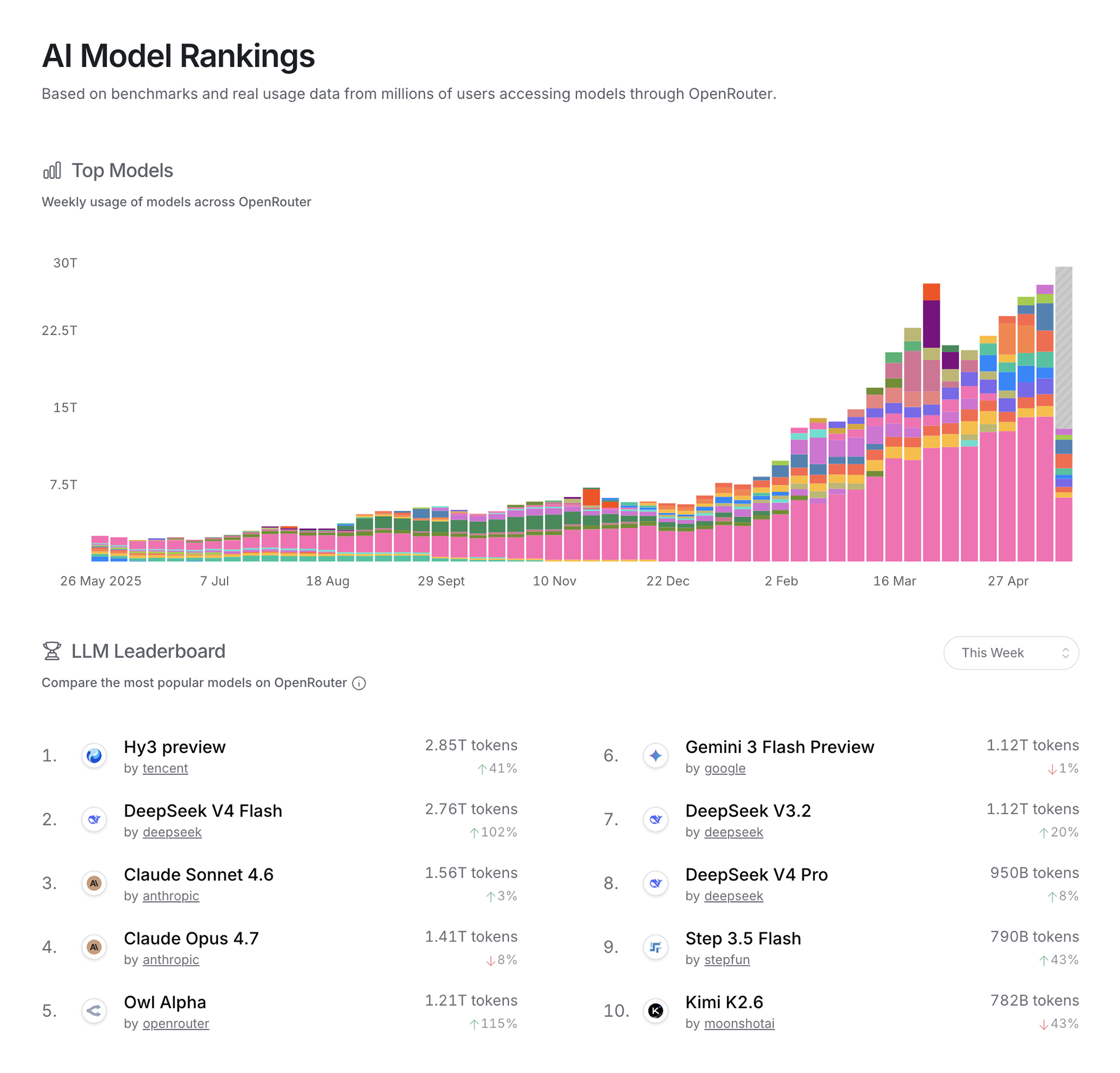
Since the first quarter, Tencent has launched several agent products for enterprises and different user groups, including WorkBuddy, QClaw, ClawPro, and Marvis. In April, it released and open-sourced Hy3 Preview. The model’s total token usage has already exceeded that of its previous generation by more than tenfold, with particularly strong growth in coding and agent scenarios. Across Tencent applications such as WorkBuddy, CodeBuddy, and QClaw, related token usage grew more than 16.5 times.
But it may still be too early to talk about returns.
“The upturn in productivity [from] AI is really something that’s happened not in the last few quarters, or even in the last few months, but the last few weeks,” Mitchell said. He added that agentic AI had broken through since the end of the first quarter in code generation and productivity use cases. As a result, this revenue was not reflected in Tencent’s first-quarter results.
In the short term, higher spending and profit pressure are now inevitable. The question is how soon AI can bring Tencent a payback.
Tencent is pushing AI plus everything
At a time when most AI applications and productivity products are still free or discounted, and user subscription habits have not yet formed, the fastest way to recover costs is to lease GPUs. Tencent is not doing that for now. Instead, it is using GPU resources to improve its own businesses.
Mitchell said Tencent has already chosen to prioritize multiple internal AI services over Tencent Cloud. “The reality is we’ve already made the choice and paid the price in that we have prioritized a multiplicity of internal services ahead of Tencent Cloud,” he said on the earnings call.
Large tech companies with cloud businesses usually have one key internal scenario that consumes GPU resources. Tencent is said to have several, including the Hunyuan foundation model, agentic development within Weixin, Yuanbao, advertising, games, WorkBuddy, and CodeBuddy. That is why Tencent Cloud has not been active in leasing out GPU capacity, he explained.
The scenarios Mitchell referred to are not limited to the Hunyuan (Hy) foundation model, WeChat’s internal agent, Yuanbao, and WorkBuddy. They also include AI deployments in advertising, games, fintech, and other businesses. Put simply, Tencent wants to push AI into everything.
Advertising has long been the business where Tencent’s integration with AI has been smoothest and where efficiency gains have been most visible.
In the first quarter, Tencent’s advertising business exceeded market expectations with growth of nearly 20%. The financial results said this was mainly because Tencent upgraded its AI-driven ad recommendation model and expanded closed-loop marketing capabilities within the WeChat ecosystem, improving ad performance and raising ad pricing. Advertising spending by internet services, e-commerce, and gaming companies grew especially strongly.
Tencent’s results show that Tencent Ads AIM+, a product suite launched last November, now covers about 30% of advertisers’ marketing service spending and has been widely used by advertisers in mini games, short dramas, and WeChat Mini Shops.
But AI is doing more than improving advertising efficiency. As Doubao and Qwen explore deeper combinations of agents and consumer behavior, the advertising industry may face a structural challenge: a shift in user entry points.
Analysts raised that issue on the earnings call.
Mitchell said this may pose a bigger risk to e-commerce platforms than to Tencent. Users actively choose to spend time watching short videos, listening to music, consuming content, or chatting with friends, he said.
By contrast, users often spend time on e-commerce sites because they are looking for the lowest price. If AI agents play a larger role in price comparison, users may spend less time on e-commerce sites and be less exposed to ads. Still, Mitchell said it is too early to draw a definitive conclusion on how AI will affect e-commerce companies, adding, “We don’t see it as a primary risk for Tencent.”
Tencent’s gaming business is also integrating AI. Its financial results show that AI has entered the R&D and experience chain, covering areas such as 3D assets, image quality, and NPC (non-playable character) interaction.
The new game Roco Kingdom: World, launched in the first quarter, is a typical case. NPC battles in the game are mainly driven by AI. On the ninth day after launch, new users surpassed 30 million, and average daily active users (DAUs) in the first month reached 13 million.
Game for Peace has also launched AI-driven teammates and characters, providing players with real-time tactical coordination and emotional companionship. Tencent data show that cumulative users of all AI NPC gameplay in the game have reached 110 million, with peak daily active users reaching 17.7 million. Message interactions in a single match can reach 70 rounds, while microphone activation is close to 75%.
AI is also lowering the barrier to user-generated content. The Oasis Era platform inside Game for Peace has built in a creation assistant, lowering the threshold for map and gameplay creation to a level where ordinary players can participate. During Lunar New Year in 2026, Oasis Era’s DAU count exceeded 58 million, and the platform had more than 150,000 gameplay modes and maps.
Capital markets, however, are focused not only on how AI can keep consumers engaged in games, but also on whether it can change the profit model of a heavily investment-driven industry. Morgan Stanley previously said in a report that AI could cut nearly half of development costs and potentially release USD 22 billion in annual profit for global game companies.
“For our game business, generative AI enables us to produce more content faster,” Mitchell said. “The objective at this point is really, you know, faster content creation and incremental revenue generation. We’re not prioritizing margin expansion per se.”
In March, 36Kr learned that Tencent’s WeChat is trying to develop an independent proprietary AI model. The model has completed the buildout of its basic capabilities and received an internal code name. It is expected to be rolled out externally in 2026.
As a superapp, WeChat’s integration with AI has long been one of the topics attracting outside attention.
36Kr has learned that WeChat plans, on one hand, to connect its proprietary model to the mini program ecosystem and support the development of various AI agents. On the other hand, it also hopes to use the model’s capabilities to explore application scenarios deeply embedded in the social ecosystem, such as improving efficiency and user experience inside WeChat based on users’ long-term behavior on the platform.
For now, WeChat seems to be hedging while searching for a better option. While incubating its own model, it has continued to use the Hy model in some products and has now upgraded to Hy3.
On the earnings call, Martin Lau, Tencent’s president, described the blueprint for AI on WeChat. In the future, he said, Tencent plans to integrate mini programs as “skills” that agents can use as tools. This could bring more traffic to mini program operators. Companies using Tencent’s agent products could improve internal productivity, while their mini programs could also be used by more users and more agents.
In this plan, mini programs appear set to become something like skills. This vision of inheriting the internet era’s assets is also one of the most compelling parts of Tencent’s AI push.
From a macro perspective, the combination of AI and video content is producing sharply different outcomes for short and long formats.
In short video, AI-generated dramas have already generated meaningful revenue, and the segment has entered a stage in which profits are becoming thinner. The combination of longform video and AI, however, remains awkward, with projects often facing criticism as soon as they appear. In April, iQiyi’s AI actor library received a harsh lesson in the court of public opinion.
On the earnings call, one analyst asked whether Tencent Video might also see AI-generated dramas become breakout content in the next few years. Mitchell answered cautiously, saying the analyst might be referring to short videos or mini drama series rather than the longform drama series that have historically been Tencent Video’s strength.
Mitchell said a “double-digit percentage” of the market likes animated content, and Tencent has natural advantages in the field because of its content IP operations, gaming business, AI technology capabilities, and strengths in certain multimodal AI areas.
AI enables Tencent to produce animated TV series faster, more cheaply, and at higher quality, Mitchell said. It also allows Tencent to bring more IP into linear video format when that IP was previously limited to novels or games.
The financial sector itself is highly data-intensive, making its combination with AI natural. Mitchell said financial services are logically positioned to receive AI-driven productivity improvements in the near future.
He used credit as an example, saying that “credit scoring has historically been more of an art than a science.” Although large volumes of data exist, only a small portion has actually been effectively input into models. Now, with transformer models, all available data can be processed more completely, allowing systems to identify which factors are truly predictive and improve lending through greater predictive accuracy.
“This is an area where many companies will be investing a great deal of time and energy, and we will be participating as well,” Mitchell said.
Tencent currently does not have much excess GPU capacity to rent out. But Mitchell said that, over the rest of this year, the situation will improve as the supply of China-designed GPUs gradually increases.
Tencent will make more capacity available through Tencent Cloud, which should help drive the cloud arm’s expansion, Mitchell said. But the tradeoff was deliberate: Tencent has been consciously late in monetizing AI through Tencent Cloud because it has been supporting multiple internal AI initiatives.
Tencent wants to make money from AI, but has not settled on how
Overall, the short-term cash returns AI is bringing Tencent are currently reflected mainly in the advertising business.
Mitchell said many Tencent products, including its expansion into games, the launch of Weixin, and its move into payments, went through long incubation periods with no immediate return on investment. Tencent backed those products because it believed they could create franchise value over time.
Most companies now investing heavily in large models are winners of the internet era, and they generally understand delayed returns. The difference is that AI may not only take longer to make money, but also burn money faster.
In the internet era, companies mainly paid bandwidth costs, while most computing power sat on users’ devices. That made near-unlimited expansion possible. In the AI era, every user served comes with a fairly high cost.
On the earnings call, an analyst asked whether Tencent’s AI products would pursue a large DAU scale or focus more on serving a small group of heavy users with strong willingness and ability to pay.
Lau said high-value use cases matter at least as much as, if not more than, simply increasing DAU and user time. The difference between the AI and internet eras, he said, is that AI is about intelligence, and the value of intelligence is reflected in how much people are willing to pay for it. In AI, every service delivered carries meaningful variable cost.
Doubao, ByteDance’s AI assistant, is already trying to make money through advertising, e-commerce, and paid subscriptions. For now, however, a fully workable business model does not exist.
Lau believes the subscription model will not be especially large in China, but that subscriptions are still necessary. He said e-commerce or advertising as monetization methods remain very early, even in the US, where eCPM (effective cost per mille) is much higher. Leading players have not yet built a robust advertising model, he said, so advertising monetization will be a long-term process and most likely a supplement to subscriptions.
Tencent is not rushing to set an ARR (annual recurring revenue) target for AI agent products because the field is changing too quickly. Mitchell said Tencent could set a target today and be off by an order of magnitude a year later in either direction, because usage demand is so dynamic. For now, the company is focused less on hitting specific ARR targets and more on building the right products.
For Tencent, the era of cost reduction and efficiency gains appears to be giving way to the cash burn of AI. The company succeeded in the previous internet cycle, but a new challenge is directly ahead. The wealth, talent, and businesses Tencent accumulated in the previous era are all being rebuilt through AI.
Judging from its share price performance, the market is somewhat nervous about that.
Mitchell said Tencent has a cash-generative business and a substantial investment portfolio, and is accelerating the process of monetizing part of that portfolio. That should allow it to sustain buybacks through the rest of the year. “We believe our share price is somewhat dislocated, and therefore it’s an opportune time for buybacks,” he said.
KrASIA features translated and adapted content that was originally published by 36Kr. This article was written by Wang Yuchan for 36Kr.
Note: RMB figures are converted to USD at rates of RMB 6.81 = USD 1 based on estimates as of May 21, 2026, unless otherwise stated. USD conversions are presented for ease of reference and may not fully match prevailing exchange rates.