
In the busy centre of Jakarta, the world’s most populous city, people are noticing how brightly colored electric vehicles, displaying the marques of either China’s BYD or Vietnam’s VinFast, are gradually taking over the streets.
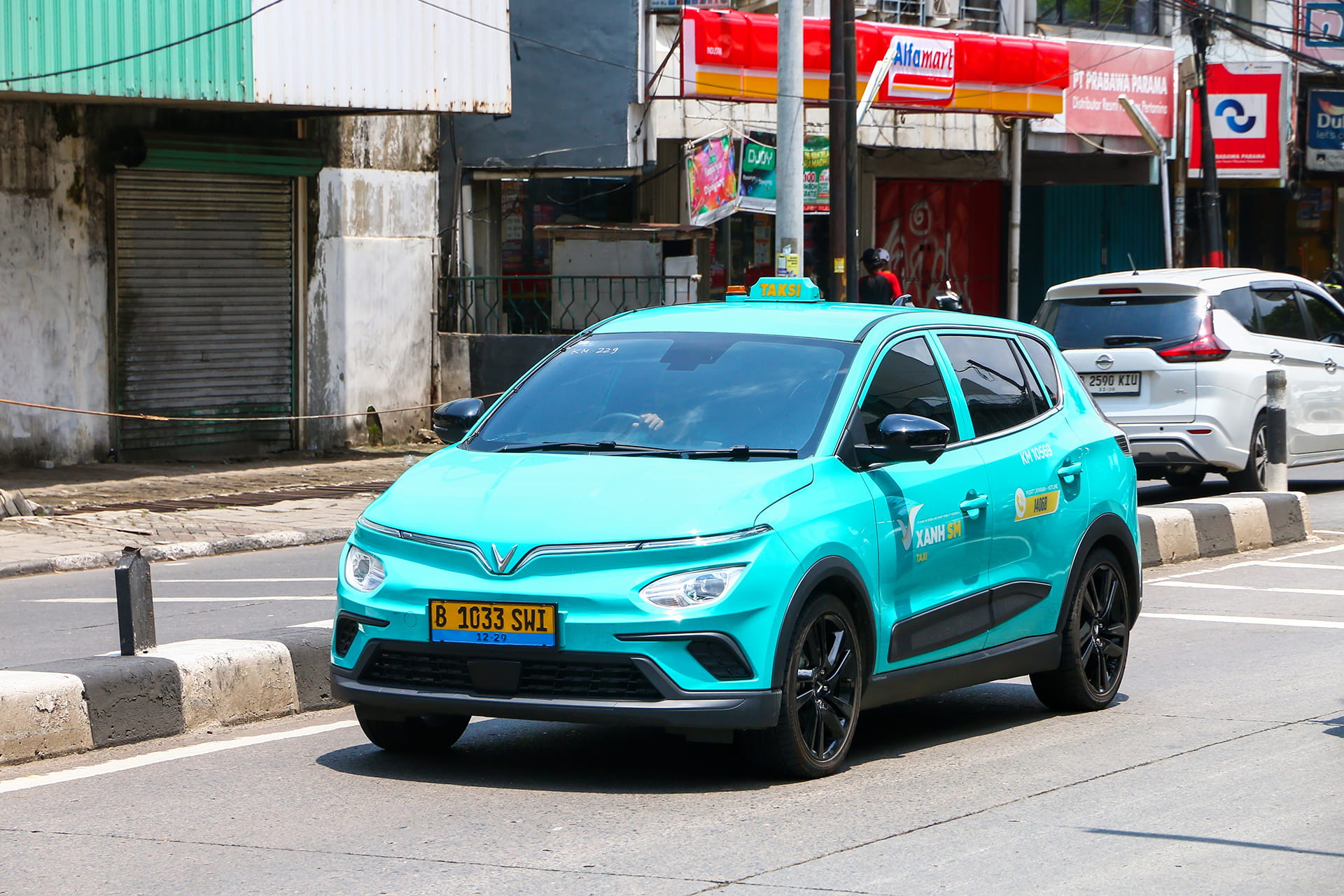
VinFast taxis in their cyan livery stand out. Launched just over a year ago, the ride-hailing service Green Smart Mobility, or Green SM, has become a popular way for residents and tourists alike to traverse the sprawling Indonesian capital.
“Electric cars are a smooth ride,” said Suminto, a driver in his 40s who switched services five months ago from rival Bluebird. He has noticed more bookings from upscale residential areas with Green SM, attributing its popularity to the fact that “since it’s a new service, the interiors are clean and the cabins are spacious.”
“Above all, it’s cheap,” he added. A 30-minute ride that would cost at least IDR 80,000 (USD 4.7) with competitors can be taken for just over IDR 30,000 (USD 1.8).
Subsidies, price undercutting and services that go beyond merely selling cars are trademark tactics for VinFast as it strives to expand beyond its home market, where it dominates with a 37% market share. In Indonesia, it is competing head-on with BYD as the two EV tigers seek to grab market share in the traditional regional strongholds of Japanese car brands.
BYD has its own taxi play here, providing EVs for Green SM’s rival Grab, in a partnership that extends to Malaysia, the Philippines, Singapore, Thailand, and Vietnam. Green SM also operates in Vietnam, Laos, and the Philippines.
“It’s a very good strategy,” said Sarina Lesmina, head of Indonesia research at brokerage CLSA. “It’s a way to introduce the experience of riding a battery EV to those who haven’t had one.”
According to PwC data, BYD and VinFast were the fastest-growing brands in Southeast Asia’s six biggest markets during the first three quarters of 2025, with sales volume jumping 95% and 90% year-on-year, respectively.
VinFast sold more than 100,000 EVs over the nine-month period in Indonesia, Vietnam, Malaysia, Singapore, Thailand, and the Philippines, followed by BYD’s 70,000 vehicles. That gave them a combined market share of roughly 7% of the total 2.4 million car sales in a region of 700 million people.
Squeezed by such competition, Japan’s auto giants, led by Toyota Motor, Honda Motor, and Mitsubishi Motors, saw their market share drop to 59%, down ten percentage points from the same period in 2023.
Honda has predicted a net loss of up to JPY 690 billion (USD 4.3 billion) for the fiscal year ending March 31, its first since its listing in 1957, with its chief Toshihiro Mibe saying this month that ASEAN’s “competitive environment is intensifying across the board due to the aggressive push by emerging car makers.”
“Consumers in Southeast Asia are generally more open to new ideas and to trying new technologies,” said Liu Xueliang, general manager of BYD’s Asia Pacific car sales division.
With a growing middle class and untapped growth potential, Southeast Asia matters more than ever to BYD, at a time when its momentum is flagging at home. It has suffered a six-month streak of sales declines in China since September of last year, amid weakening domestic demand.
“Competition has become extremely intense in China, and some government subsidies have been lowered this year,” said Ming Hsun Lee, head of greater China automotive and industrial research at BofA Global Research, adding that higher costs for batteries, memory chips and critical metals were also piling pressure on the country’s carmakers.
“Operating profits across China’s auto industry have come under strain, which makes overseas expansion increasingly important,” Lee added.
“[Southeast Asia] is a market where the economy, population and middle-class consumers are all expanding rapidly,” according to Li Chengdong, founder of Beijing-based e-commerce consultancy Haitun. “On top of that, [Chinese] brands deemed the market as relatively less competitive, with only Japanese companies serving as major players.”
While BYD faces intense competition domestically, VinFast is a clear leader in its home market, where it continues to generate most of its revenues while trying to build name recognition abroad.
“[VinFast]’s cars are not yet as popular as BYD’s. This is [about] brand perception,” said CLSA’s Lesmina, adding that BYD has enjoyed early success by labeling itself as a high-tech company offering “cool design”.
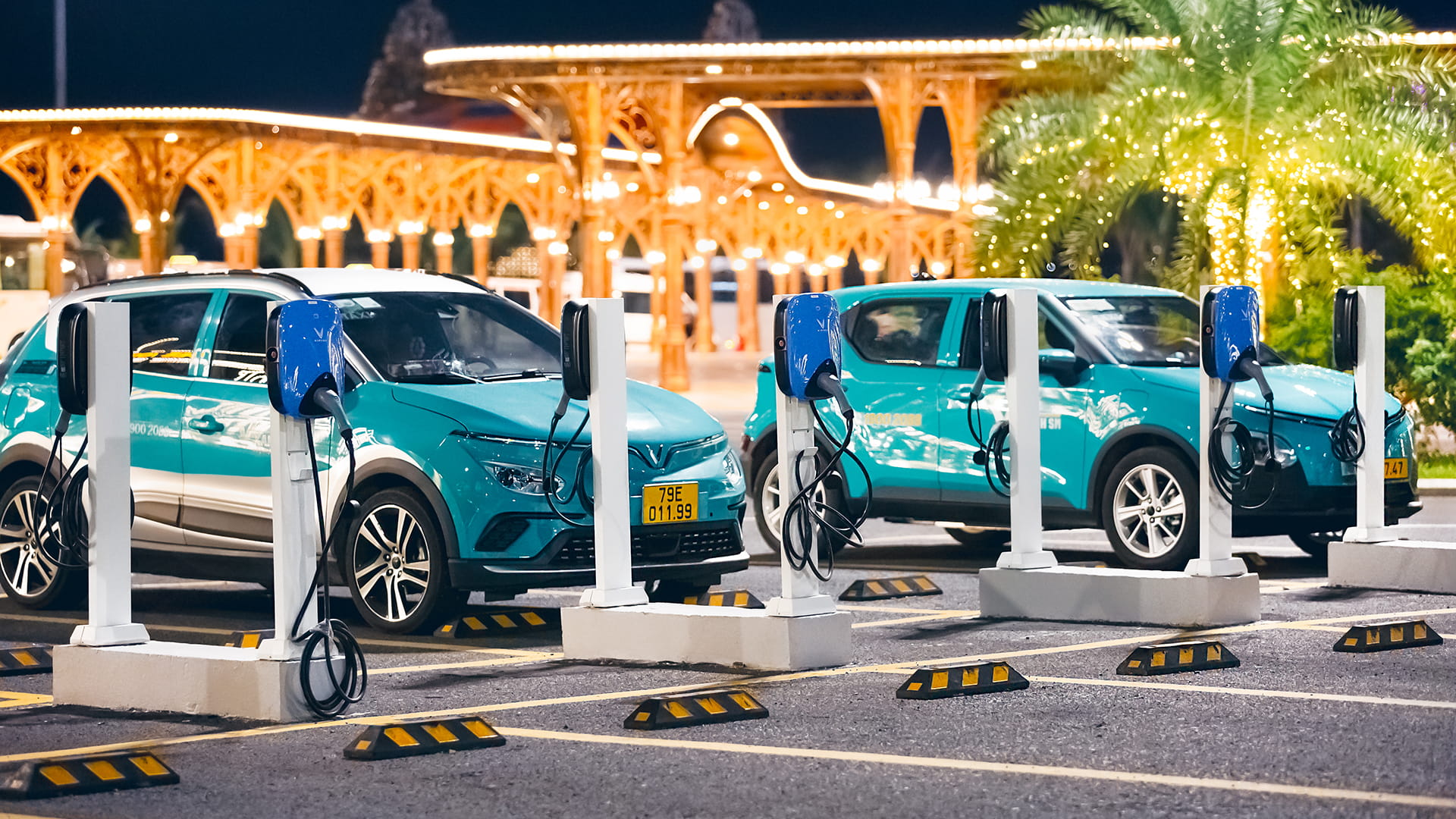
To raise its profile, VinFast has not only assembled a taxi fleet in Indonesia but also participated in local infrastructure projects such as a toll road interchange in West Java, all part of a USD 1 billion Indonesian investment strategy, it said, that includes manufacturing, sales, service networks and charging infrastructure.
Thuc Than, senior analyst at Vietcap Securities, describes its “ecosystem approach” as one of its competitive advantages in overseas markets, which “should support a gradual improvement in brand awareness and market penetration over time,” despite the execution risks of “long-term commitments.”
In the short term, lower price tags could yield quicker results with budget-conscious buyers. “VinFast’s opportunity lies more in targeting different customer segments, particularly in emerging markets where factors such as total cost of ownership … and overall value for money are both considered,” Thuc said.
Yet success has been harder to find in India’s vast market, where VinFast cars are aggressively priced, starting at INR 1.72 million (or about USD 18,400), compared with BYD’s cheapest offering at INR 2.49 million (or approximately USD 26,640).
VinFast officially launched in India in September and sold just 1,195 cars in the three months from December to February. BYD, which introduced its first cars more than three years ago, only sold 774 vehicles during the three-month period, data from the Federation of Automobile Dealers Associations showed.
A limited charging network, fears about resale value, the strength of entrenched brands such as Japan’s Maruti Suzuki and consumer resistance to EVs, which accounted for only 3.5% of sales in India in February, are factors behind the lack of headway. BYD has also suffered from the government’s scrutiny of Chinese investments in India.
Nevertheless, VinFast has built a factory in the southern Indian state of Tamil Nadu capable of making 50,000 cars a year, with plans to expand capacity to 150,000. It has proposed spending USD 3 billion in central Telangana state on an electric cab business and an ecosystem that includes a smart city, hospitals, schools, and even a zoo.
VinFast also has a factory in Indonesia, while BYD opened its first wholly-owned overseas factory in Thailand in 2024 and is expected to launch a new production facility in Indonesia this year. The company also has an assembly line in India and is constructing another one in Cambodia.
The Vietnamese company went all in on pure battery-powered cars after ceasing production of internal combustion engine vehicles in late 2022. But adoption has slowed as many buyers have turned to plug-in and other hybrid types as more practical solutions for their needs.
“Another major edge for BYD lies in its highly mature plug-in hybrid technology, which could considerably alleviate consumers’ range anxiety since they can always refuel [their cars] with gasoline … especially in markets outside China,” said Lee from BofA.
He expects BYD to soon increase the share of plug-in hybrids in its product portfolio across emerging markets, including Southeast Asia, as a certification process, typically longer than for pure EVs, nears completion this year. “BYD is slowly building itself up toward a stampede,” he said.
During an earnings call, VinFast that it was planning to add small engines back onto its cars to create a hybrid model.
It is also looking across the Pacific Ocean, where geopolitics may open doors closed to BYD. The Nasdaq-listed EV maker said earlier this month that it would resume construction of a delayed USD 2 billion factory in the US state of North Carolina in 2026, capable of producing 150,000 cars a year, with the goal of beginning operations in 2028.
“Policies like the US Inflation Reduction Act and heavy tariffs effectively lock out Chinese EVs. We don’t have BYD competing here,” said New York-based analyst Jesse Sobelson at BTIG.
With such major factory investments planned globally, analysts are keeping a close eye on the financial positions of the two national EV champions, assessing whether they can sustain themselves through what BYD founder Wang Chuanfu has called a marathon of “cash burn.”
VinFast’s net loss widened 26% to a record USD 3.87 billion in 2025 due to rising expenses, and it has now accumulated USD 9 billion in losses over the past three years.
The Hanoi-based automaker was founded in 2017 by Vietnam’s richest man, Pham Nhat Vuong, whose private conglomerate Vingroup spans real estate, retail, and education. Vuong has boldly declared he would finance VinFast until he runs out of money.
“VinFast can be overconfident because it has the financial backing of its parent Vingroup, which has deep pockets, and it is a favorite of Vuong,” said Tim Daiss, principal at APAC Energy Consultancy.
“Pure financial decisions, if you will, would dictate not building the [North Carolina] plant, but VinFast isn’t playing on pure corporate pragmatism.”
That means the global drive will continue. “Over the past year, VinFast has continued expanding its presence across several international markets outside Vietnam, focusing on … strengthening partnerships and developing its EV ecosystem,” said Duong Thi Thu Trang, VinFast’s deputy CEO of Global Automotives.
It is targeting 20–30% of its deliveries this year to be in overseas markets. With a global sales target of 300,000 cars for 2026, that equates to 60,000–90,000 vehicles sold abroad, at least tripling the 21,820 recorded in 2025.
BYD had a cash hoard of RMB 102 billion (USD 14.8 billion) as of the third quarter of 2025 and earned around RMB 7,000 (USD 1,015.6) on each car sold. Analysts at Chinese brokerage CMBI forecast a 30% rise in BYD’s net profit this year, citing the company’s “high asset quality” and a “prudent” attitude toward expense control.
Both companies see a windfall from skyrocketing gasoline prices driven by the war in Iran. In March, VinFast announced discounts in India, Indonesia, Vietnam, and the Philippines for motorists switching from conventional engines to electric models.
And BYD said attitudes are changing in Australia. “We’ve been crazy busy lately,” said a salesperson in a social media video filmed at a showroom in Perth.”[We] are selling more than ten cars each day.”
This article first appeared on Nikkei Asia. It has been republished here as part of 36Kr’s ongoing partnership with Nikkei.
Note: IDR, JPY, RMB figures are converted to USD at rates of IDR 17003.11 = USD 1 and JPY 159.70 = USD 1 and RMB 6.89 = USD 1 based on estimates as of April 6, 2026, unless otherwise stated. USD conversions are presented for ease of reference and may not fully match prevailing exchange rates.