
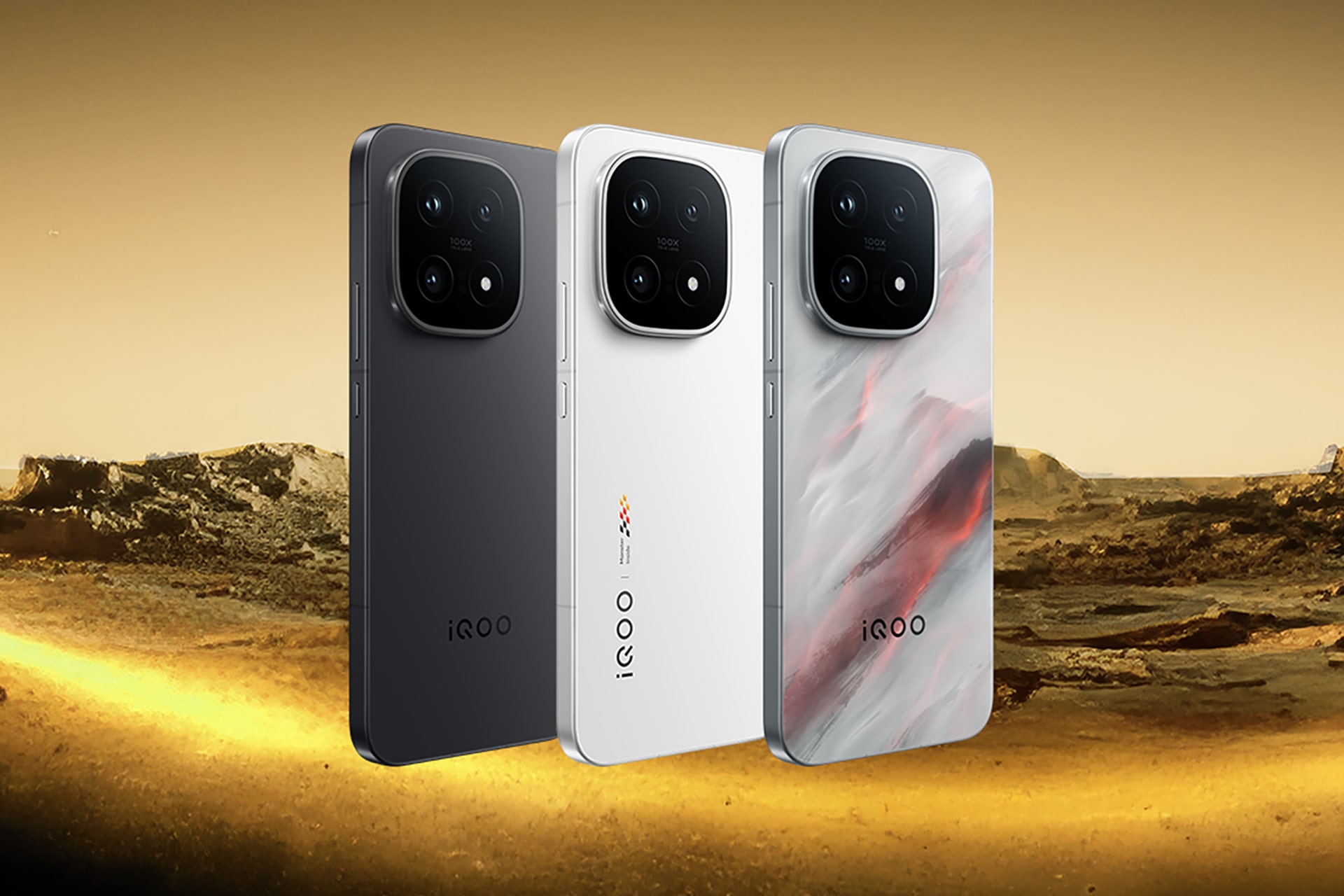
iQOO, a sub-brand of Chinese smartphone maker vivo, has launched its latest flagship smartphone, the iQOO 15, as it moves to redefine itself beyond a strictly performance-first identity. The company positions the device as its most fully realized smartphone to date, combining gaming-oriented hardware with a renewed emphasis on display quality, power efficiency, and comfort.
About the iQOO 15
The iQOO 15 is powered by Qualcomm’s Snapdragon 8 Elite Gen 5 (Mobile Platform), built on a three-nanometer process, making it among the first smartphones globally to ship with the chip. Alongside the main processor, the device integrates a proprietary Q3 chip designed to manage graphics-intensive tasks such as super resolution, frame interpolation, and ray tracing.
The phone runs OriginOS 6, based on Android 16. iQOO describes it as its smoothest software version to date, citing system-wide animation upgrades intended to improve responsiveness and visual continuity.
Its display delivers a resolution of 3,168 by 1,440 pixels at 508 pixels per inch, with a 1–144 Hz adaptive refresh rate enabled by 8T LTPO technology. Power comes from a 7,000 milliampere-hour silicon anode battery, supporting 100-watt wired fast charging and 40-watt wireless charging.
The device carries both IP68 and IP69 ratings for dust and water resistance and is available in multiple configurations, scaling up to 16 gigabytes of RAM and one terabyte of storage.
It is offered in three colorways, including a gray-based variant limited to select markets.
Display takes center stage
The defining feature of the iQOO 15 is its 6.85-inch Samsung 2K M14 OLED display, built on a flat panel and jointly customized with Samsung Display. The panel uses Samsung Display’s trademarked LEAD technology, which stands for low-power, eco-friendly, augmented brightness, and design (optimized for slimness and lightness).
LEAD improves power efficiency by removing the polarizer layer and introducing a new panel stack structure. According to Samsung, eliminating the polarizer increases light transmittance by more than 1.5 times at the same power consumption, allowing the display to achieve comparable brightness levels while using less energy.
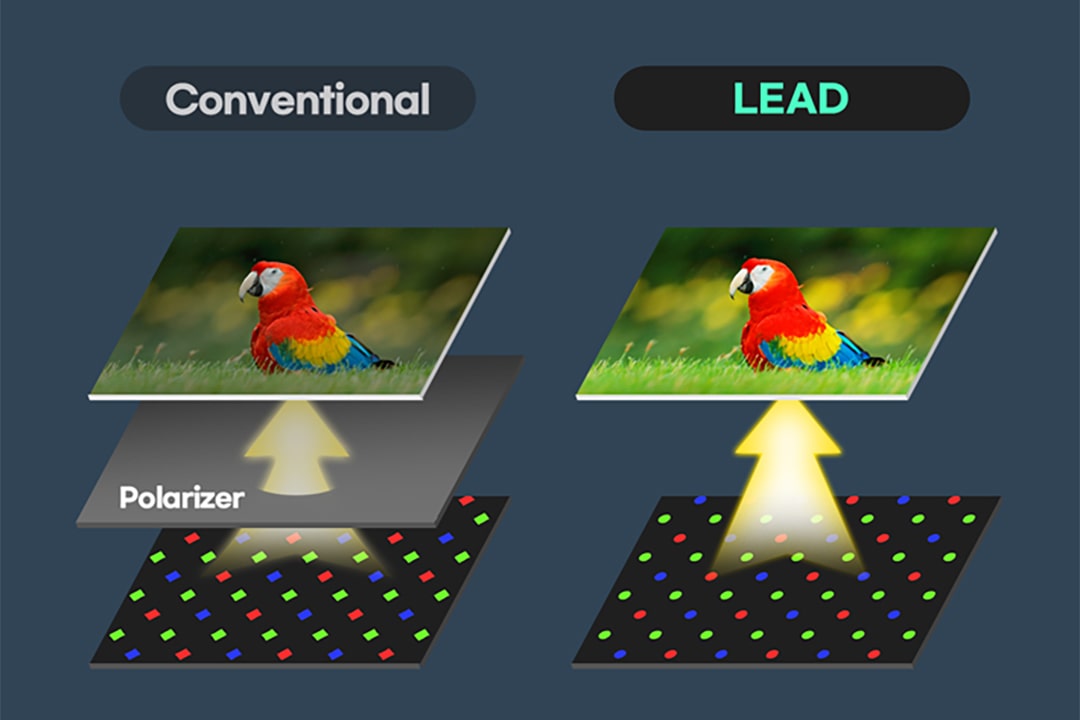
Phone displays without polarizers remain uncommon due to challenges such as higher reflectance and potential color washout. To mitigate these effects, iQOO and Samsung Display developed a nano photolithography color filter that applies color film more precisely at the pixel level.
This expands the color gamut to 118% NTSC, meaning the display can reproduce a wider range of colors than the NTSC reference standard. The overlapping film design also reduces ambient light reflection from the metal layer, while an anti-reflective coating on the cover glass further improves visual clarity.
According to iQOO, the display solution required nearly 20 months of joint R&D, multiple prototype iterations, and dozens of validation cycles.
Focus on brightness, dimming, and eye comfort
The iQOO 15 emphasizes extended usability through layered brightness and dimming controls. Local peak brightness reaches up to 6,000 nits for scenarios such as gaming and live streaming, while global peak brightness is capped at 2,600 nits. Manual full-screen brightness reaches 1,000 nits, and the panel can dim down to as low as one nit in low-light environments.
To address eye comfort across varying conditions, the display combines 2,160 Hz PWM dimming at low brightness with DC dimming at higher brightness levels, rather than relying on a single dimming method. A triple ambient light sensor enables faster brightness transitions as users move between lighting environments, which iQOO said improves response speed by up to 40% without manual adjustment.
The panel renders up to 1.07 billion colors and is the first iQOO device to receive Dolby Vision certification. It is also certified by TÜV Rheinland for “Full Care Display,” “Circular Polarization,” and “Flicker-free” standards.
What has changed
Compared with the 2K 144 Hz “Ultra Eyecare” display used on the iQOO 13, the iQOO 15 adopts a next-generation LTPO OLED implementation. According to vivo Labs, the new light-emitting material delivers up to a 40% improvement in light-emitting efficiency, a 60% reduction in motion blur, a 50% increase in lifespan, and a 44% reduction in power consumption.
The polarization-free design is also intended to produce light that more closely resembles natural daylight, which is said to support more comfortable viewing during prolonged use.

Despite its wider focus, gaming remains central to the device’s design. The iQOO 15 includes a dual-axis vibration motor that enables what the company describes as “true 4D vibration,” intended at delivering more immersive tactile feedback during gameplay.
Touch responsiveness has also been improved through chip- and algorithm-level optimization, enabling a 3,200 Hz touch sampling rate alongside a stable 360 Hz ten-finger touch rate. These changes are aimed at genres such as shooters, where consistent and rapid input response is critical.
Overall, the iQOO 15 is positioned for mobile gamers seeking high-end performance without compromising comfort during extended sessions. It also targets heavy video consumers drawn to high brightness, rich color reproduction, and Dolby Vision-certified playback, as well as users who are sensitive to eye strain and prioritize display quality for daily use.
This article was published in partnership with iQOO.