
Reports that Chinese artificial intelligence company Moonshot AI is preparing for an IPO in Hong Kong have intensified in recent weeks, with market reports indicating that it could file a listing application with the Hong Kong Stock Exchange as soon as August, or by September 30.
The pattern resembles the run-up to the listings of Z.ai and MiniMax.
Throughout 2025, Moonshot AI was among China’s most closely watched large language model (LLM) developers, alongside companies such as DeepSeek. But when it came to the public markets, Z.ai and MiniMax moved first, completing their Hong Kong listings ahead of Moonshot AI.
Moonshot AI did not appear to be in a rush. In an internal letter at the end of 2025, founder Yang Zhilin said the company held more than RMB 10 billion (USD 1.5 billion) in cash after completing its Series C round and could still raise substantial capital privately. As a result, he said, there was no urgency to go public in the short term.
But the experience of Z.ai and MiniMax since listing has highlighted another benefit of the public markets: an IPO is not just a one-time fundraising event; it also creates a channel for follow-on financing.
In July, Z.ai raised about HKD 31.4 billion (USD 4 billion) by issuing new shares equivalent to about 4.25% of its enlarged share capital. MiniMax later placed 35.6 million new shares and issued HKD 6.5 billion (USD 829 million) in convertible bonds.
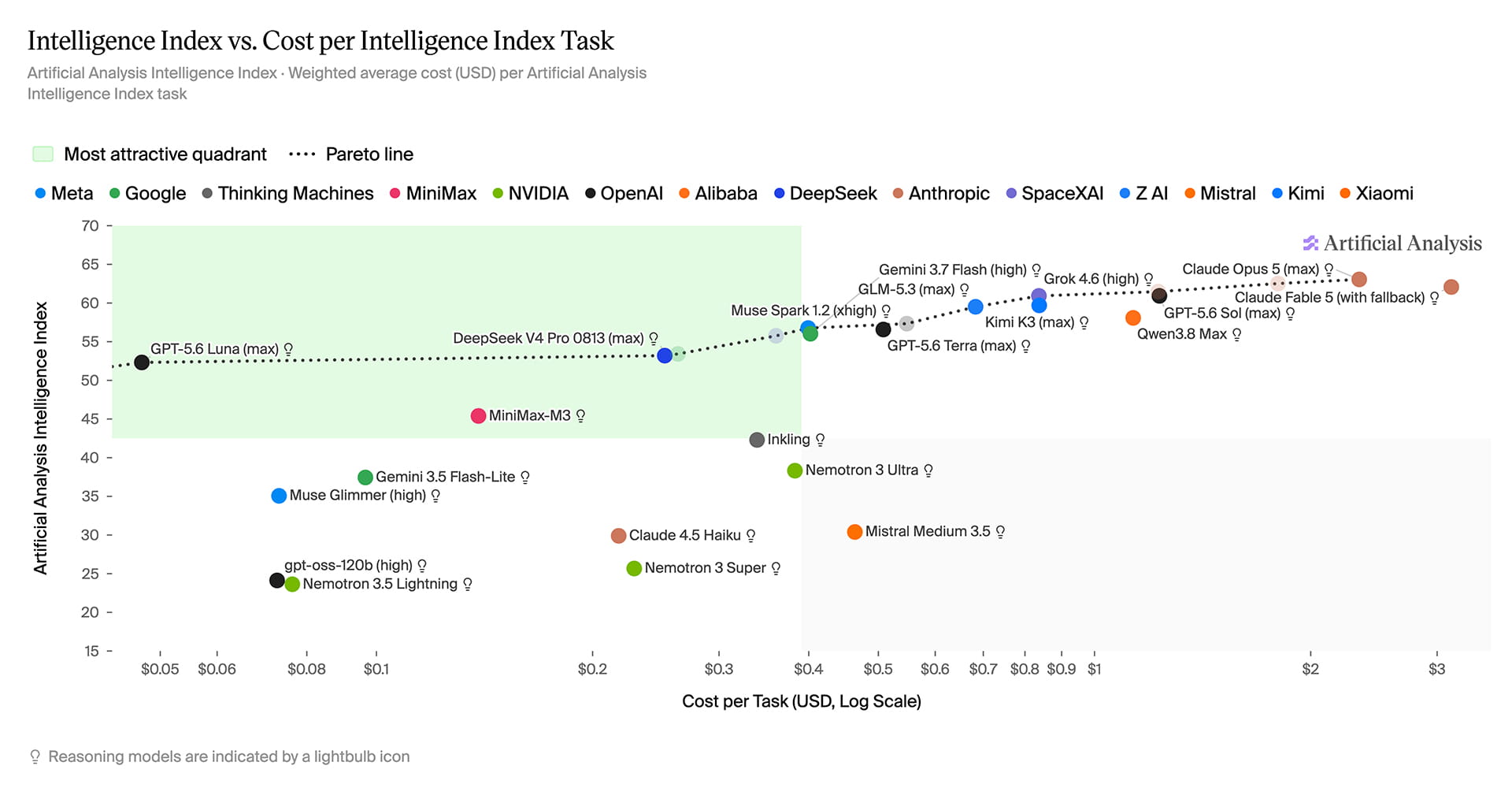
Moonshot AI, meanwhile, largely faded from market attention until the launch of Kimi K3. On Artificial Analysis’ overall leaderboard, Kimi K3 ranked behind only flagship models from Anthropic and OpenAI.
Kimi K3 creates an IPO window
Artificial Analysis’ rankings offer one way to understand what investors may value in frontier AI models. Its charts compare overall model performance with the cost of completing a task. Models positioned higher perform better, while those farther to the left cost less to use.
The comparison matters because investors are unlikely to value price-performance alone. Capability comes first for frontier models, while lower costs can support adoption and improve the economics of serving users.
OpenAI and Anthropic have shown that highly capable models can support strong demand and premium pricing. Competing mainly on price, by contrast, makes differentiation harder, especially when open-source models such as DeepSeek can put further pressure on costs.
That is what makes Kimi K3 important for Moonshot AI.
On the Artificial Analysis leaderboard published at the time, Kimi K3 ranked third, close to the leading models from Anthropic and OpenAI, while costing less to use.
If Moonshot AI goes public while Kimi K3 remains near the frontier, it could offer Hong Kong investors another way to gain exposure to Chinese LLM developers. The attention around Kimi K3 could also support a higher valuation and lower the cost of future financing.
The timing, however, matters.
Z.ai and MiniMax have traded differently since their respective listings, suggesting that investors may place a premium on LLM companies that are, at a given moment, close to the technological frontier and seen as credible contenders for the strongest models.
The problem is that LLMs are improving quickly, and few companies can hold an absolute lead for long. OpenAI’s advantage has come under greater pressure from Anthropic, while Google’s relative position has also shifted in 2026 after a strong showing in 2025.
New competition continues to emerge. On August 12, DeepSeek released the official version of V4 Pro. According to Artificial Analysis, its overall score was lower than Kimi K3’s, but its cost advantage was substantial. At current pricing, its per-task cost was less than 10% of Kimi K3’s.
That means the combination of performance and cost that currently supports Kimi K3’s appeal could be challenged quickly by another model.
More broadly, most leading LLMs are still based on transformer architectures or variants of them, while the industry’s main technical approaches are converging. Developers are advancing along many of the same fronts, including mixture-of-experts architectures, better training data, longer context windows, reinforcement learning, and agent capabilities.
Competition is therefore becoming a race of continuous iteration rather than one in which a single proprietary breakthrough can create a lasting lead.
Once a capability has been demonstrated by one company, rivals can often reproduce part of it through techniques such as model distillation and further training.
That does not mean general-purpose models will become identical. But in high-demand areas such as coding, competing models may gradually move toward similar levels of commercial usefulness.
In other words, competition among LLM developers in China and overseas remains far from settled, and no technological lead can be assumed to last.
For Moonshot AI, going public while Kimi K3 remains competitive could allow it to turn a temporary technology advantage into a financing advantage, giving it more capital for the next stage of model development.
RELATED ARTICLE

Compute becomes the next constraint
In OpenRouter’s latest ranking of token consumption, Chinese-developed models occupied six of the top spots, but Kimi K3 did not make the top ten.
That stands out because Kimi K2.5 and K2.6 both appeared in OpenRouter’s usage rankings soon after their releases earlier this year. K3 also briefly entered the top ten after launch.
The weaker showing does not necessarily mean users have rejected the model. One possible explanation is that access to Kimi K3 has remained limited by cost and available computing capacity.
On July 19, shortly after Kimi K3 was released, Moonshot AI said user requests over the previous 48 hours had far exceeded expectations and were approaching the limits of its existing compute clusters.
To protect service for existing subscribers, the company temporarily suspended new consumer subscriptions and prioritized available computing capacity for current paying users.
Moonshot AI has since resumed accepting new subscribers. But the temporary limits exposed a problem: immediately after Kimi K3’s launch, its available compute capacity struggled to keep up with demand.
Z.ai faced a similar issue earlier this year. After GLM-5 was released in February, demand exceeded expectations and some subscribers encountered usage limits during peak periods. Z.ai subsequently increased capital spending on compute. By the end of June, the company had used more than 93% of the net proceeds from its Hong Kong IPO, with much of the money directed toward model R&D and computing infrastructure.
That points to a broader constraint for companies trying to compete at the frontier of LLM performance: better models require not only research breakthroughs, but also enough infrastructure to train and serve them at scale.
Moonshot AI is not short of cash. Based on publicly reported figures, the company raised about USD 3 billion across multiple funding rounds from January through May this year.
Combined with the more than RMB 10 billion in cash it held at the end of 2025, Moonshot AI already had greater financial resources than Z.ai did at the time of its IPO, even before counting the USD 3.5 billion round Bloomberg reported it completed in July.
Kimi K3 has both a higher total parameter count and more active parameters than GLM-5.2, which means it also requires more compute. In theory, Moonshot AI’s cash reserves should give it more room to secure that capacity.
Yet the company still encountered a bottleneck soon after Kimi K3 launched. That suggests its earlier investment in compute may not have kept pace with the jump in demand following the model upgrade.
Z.ai has said in a share placement announcement that it expects to use the more than HKD 30 billion (USD 3.8 billion) it raised before 2027.
Moonshot AI could face similar pressure if it continues developing models with large parameter counts, as both training and inference requirements are likely to increase.
This points to a wider challenge for Chinese LLM companies. If they continue narrowing the performance gap with leading overseas models, one of the next constraints may be the scale of their computing infrastructure. Closing that gap will require large amounts of capital.
According to Stanford University’s “2026 AI Index Report,” OpenAI spent USD 16.3 billion on compute services in 2025. OpenAI management has also said the company plans to spend about USD 50 billion on compute in 2026.
OpenAI is also directly involved in data center development through the Stargate project.
Anthropic, meanwhile, is expected to spend about USD 19 billion on compute services in 2026, according to The Information.
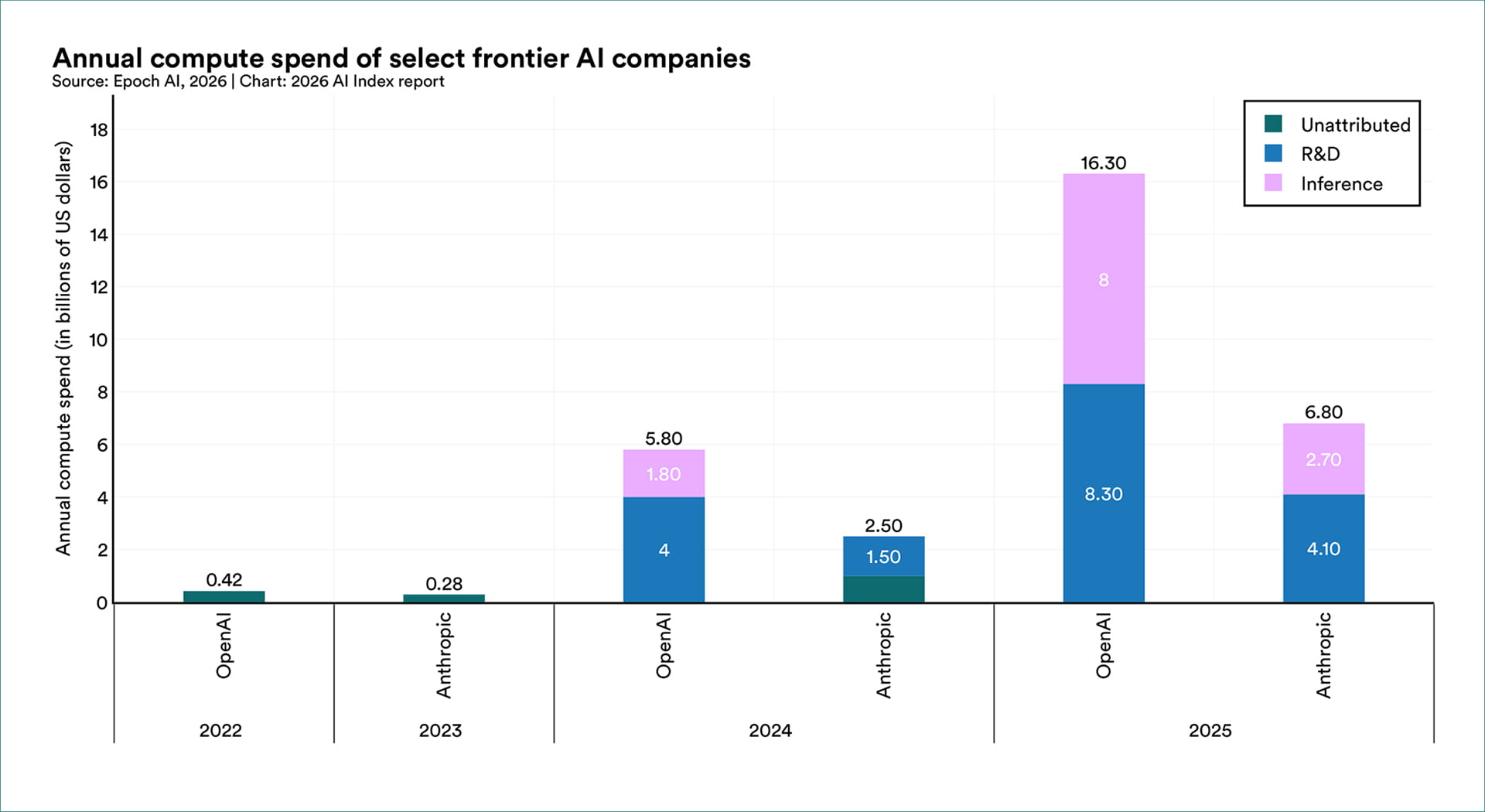
The comparison highlights a gap that model benchmarks alone do not capture. Chinese companies such as Moonshot AI and Z.ai have moved closer to leading overseas models in performance, and their valuations have risen accordingly. But their access to capital and scale of compute spending remain much smaller.
At one point, Z.ai’s valuation approached one-sixth of OpenAI’s. Its funding capacity and compute expenditure, however, remained far below OpenAI’s.
As AI models converge in performance, the next competitive test may be less about who can produce a strong benchmark score and more about who can serve large numbers of users reliably and at a sustainable cost.
That still depends heavily on compute.
After making rapid gains in model capability, Chinese LLM developers may therefore need to close the gap in capital and computing infrastructure. That could also help explain why DeepSeek has taken the unusual step of raising external capital this year.
For Moonshot AI, accessing the public markets while Kimi K3 still supports a valuation premium could provide a more sustainable source of financing for that next phase of competition.
KrASIA features translated and adapted content that was originally published by 36Kr. This article was written by Fan Liang for 36Kr.
Note: HKD, RMB figures are converted to USD at rates of HKD 7.84 = USD 1 and RMB 6.75 = USD 1 based on estimates as of August 20, 2026, unless otherwise stated. USD conversions are presented for ease of reference and may not fully match prevailing exchange rates.