
On June 9, Saidou Technology, a company backed by Seres, launched its new brand AIVA in Beijing. It also announced a partnership with Volcano Engine, a ByteDance subsidiary, to jointly define and design what it calls an artificial intelligence-native vehicle experience, meaning one built around AI capabilities from the start.
Volcano Engine will provide AIVA with technical services, including the Doubao large language model and intelligent cockpit capabilities, according to the company. AIVA said the partnership is intended to improve in-vehicle interaction.
At the launch event, AIVA brand president and product manager Li Bo unveiled the brand’s name and logo. AIVA stands for “artificial intelligence voyage ahead,” meaning AI will accompany users as they move forward, according to the brand.
AIVA also introduced its vehicle development approach, which it calls “AI before the car.” The idea is to define each product around AI from the earliest stage of vehicle development.
Li said AIVA’s “AI-defined vehicles” will be developed by first building an AI-native organization, then using that foundation to create AI-native vehicle products.
Within that organization, AI is intended to be applied across three layers: perception, decision-making, and execution. AIVA said this structure will create a feedback loop that allows the organization to keep learning and improving.
At the product level, AIVA said AI can be used for data analysis, trend identification, needs assessment, and reasoning. Product managers could then use those insights to select development directions with clearer value. The company described vehicles developed this way as products shaped by AI’s understanding of users, with emotional warmth and adaptability across different scenarios.
AIVA also unveiled its first concept car, the Origin Concept, as an expression of the brand’s philosophy. The company said the concept starts from a large model and uses biomechanics to reinterpret the vehicle’s overall form, giving AI a physical expression that can be seen, heard, perceived, and responded to.
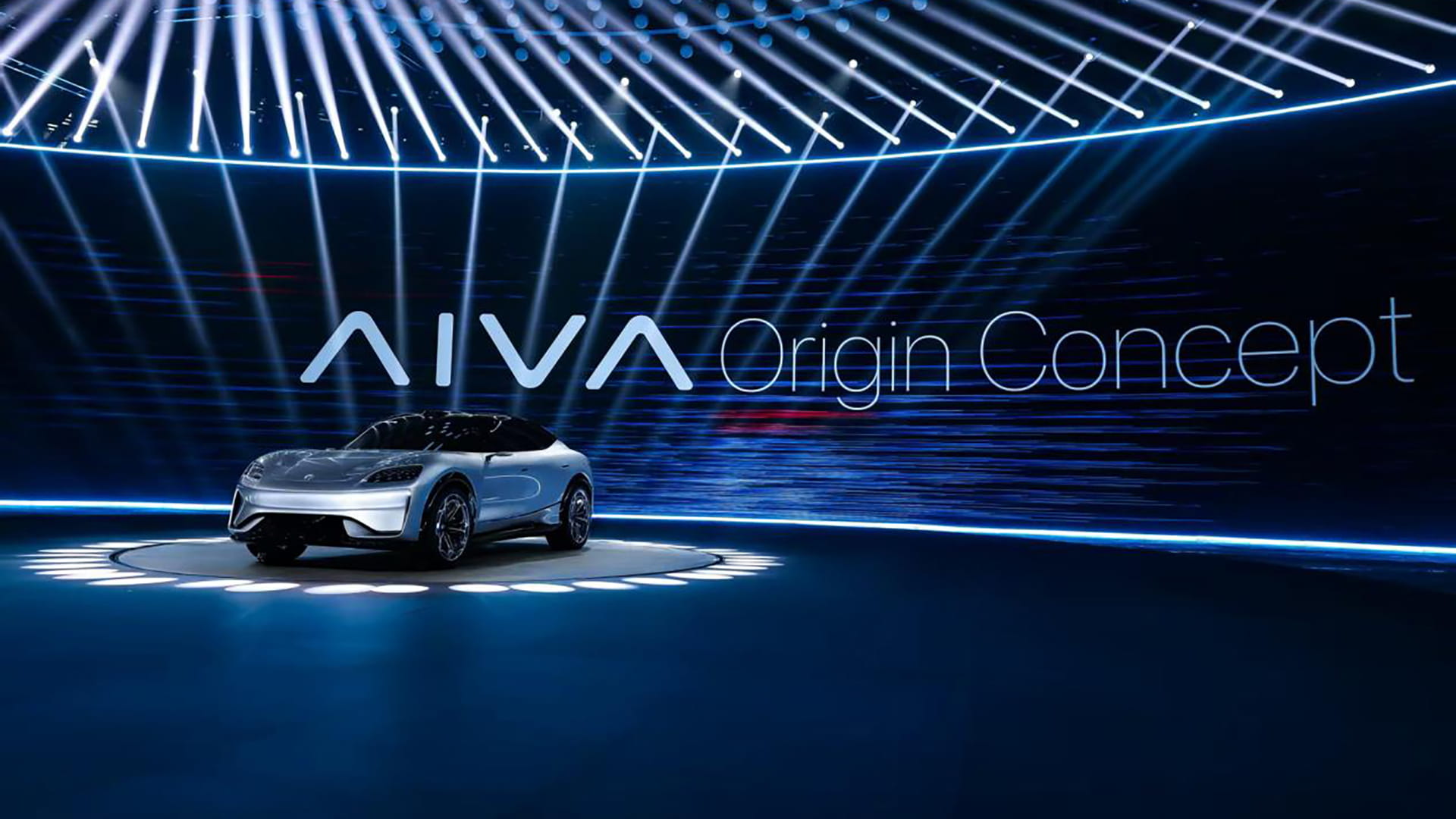
AIVA’s first production vehicle, the ME7, will be unveiled in 2026, according to the company. Its full lineup will target the mainstream market above RMB 200,000 (USD 29,546).
The brand said it will maintain an efficient pace of product iteration and continue expanding its portfolio. All models will be refined around four core areas: AI interaction, emotional companionship, intelligent experience, and driving safety.
“2026 is being seen as the first year of physical AI. As a carrier equipped with sensors and actuators, the car is a core scenario for the implementation of physical AI,” said Yang Liwei, vice president of Volcano Engine. Yang added that he sees AI evolving from turn-based chatbots toward agentic AI and physical AI.
According to company materials, AIVA is not operated by a single corporate entity. Instead, it is described as an independently operated brand coordinated across several industrial partners:
- AIVA is responsible for branding, products, and business development.
- Seres provides support in vehicle manufacturing, supply chain management, quality systems, and engineering.
- Contemporary Amperex Technology (CATL) provides energy solutions covering battery technology, battery safety, and power battery charging and swapping systems.
- A state-owned capital platform provides industrial resources, while Volcano Engine provides the technical foundation for AIVA’s AI capabilities and supports the optimization of its in-vehicle interaction experience.
Public information shows that Saidou was formed in late May through the renaming and restructuring of Landian Technology, which was previously under Seres. Chongqing state-owned asset managers together hold 34.5% of Saidou, making them its largest shareholder group. Seres holds 32.96%, ranking second, while CATL holds 9.89%, ranking fourth.
AIVA’s brand team also has ties to Seres. Chairman Zhang Zhengyuan serves as an employee director and assistant vice president at Seres, while Li was previously a vice president of the automotive group.
This article was adapted based on a feature originally written by SY and published on IPO Zaozhidao. KrASIA is authorized to translate, adapt, and publish its contents.
Note: RMB figures are converted to USD at rates of RMB 6.77 = USD 1 based on estimates as of June 15, 2026, unless otherwise stated. USD conversions are presented for ease of reference and may not fully match prevailing exchange rates.