
Las Vegas was busy earlier this month as global technology companies gathered for CES 2026. Among the exhibitors, Chinese firms were especially visible, including business internet-of-things (BIoT) player Sunmi Technology, which joined the event’s roster for the first time.
The appearance was one of several by the company in the US over a short span. On the opposite coast, Sunmi also took part in the NRF exhibition in New York, commonly known as Retail’s Big Show, joining companies such as Stripe, Softpay, and Google in discussions around payment standards and retail efficiency. It then capped off the first half of January by opening its 100th Sunmi Home outlet on Manhattan’s Eighth Avenue.
Taken together, the three appearances map onto Sunmi’s globalization strategy, spanning product development, partner ecosystems, and on-the-ground service.
The BIoT segment rarely draws consumer attention, but it underpins the systems that keep cross-border operations running, particularly in payments, device management, and retail workflows. For companies expanding overseas, reliability in this layer often determines whether scaling is sustainable. Sunmi’s recent initiatives suggest it is aiming to own that reliability as it expands its international footprint.
Getting hands-on with innovation

Although Sunmi has operated for more than a decade, CES 2026 marked its first appearance at the show. At the center of its booth was the CPad series, which the company frames as a new generation of consumer-facing tablet hardware for commercial use.
According to Sunmi, the CPad series is organized under two product lines:
- CPad is a commercial tablet that can be paired with more than 15 types of professional peripherals, including barcode scanners, printers, ID card readers, and cash drawers. It can function as a point-of-sale terminal at the front-of-house in restaurants and retail stores, or be deployed deeper inside factories and warehouses, adapting to different operational needs.
- CPad Pay builds on the base CPad by integrating financial-grade payment capabilities to support card and near-field communication (NFC) transactions. Sunmi positions it as a hybrid device that can operate as a mobile point-of-sale (POS) terminal or, when connected to a desktop system, as a secondary smart display. In the latter setup, the screen facing customers can show advertisements and order confirmations, while staff handle payments on the opposite side.
All CPad devices feature metal contact points and a “Quick Lock” mechanism on the back, allowing them to connect with more than 15 accessories.
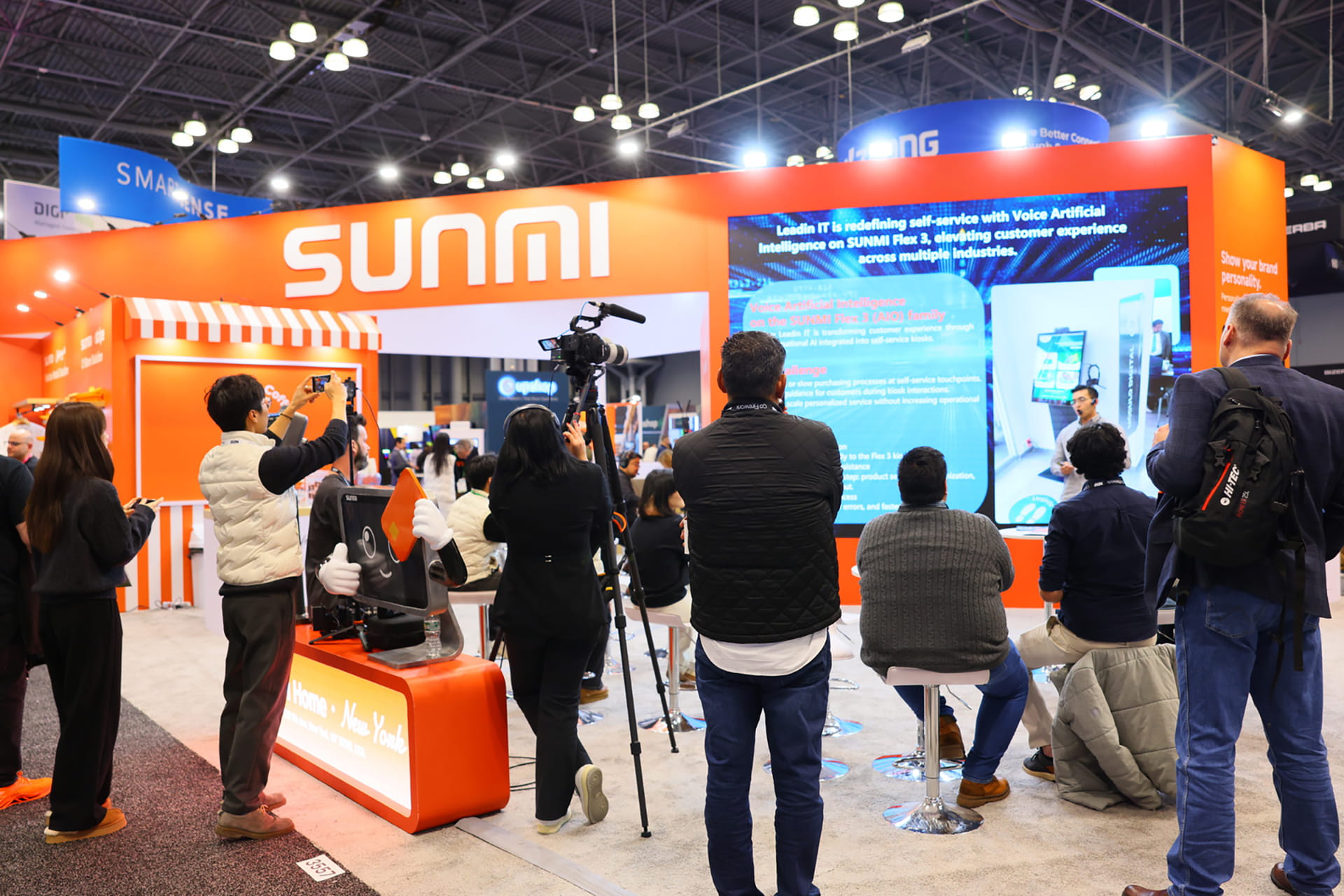
At the CES booth, Timber Zhou, Sunmi’s marketing director, demonstrated the device’s magnetic system. A tablet snapped into its base and functioned as a desktop register with printing capability. Detached and fitted with a rotating hand strap, it became a portable terminal rated IP54 for water and dust resistance.
CPad’s product structure reflects Sunmi’s observations in North America, where the company studied how merchants operate across different environments and found many relying on fragmented setups that pair consumer tablets with third-party accessories, Zhou said. Such configurations can drive up maintenance costs and still fall short on functionality.
Launched in early 2025, the CPad series has been positioned as a response to those challenges in overseas markets. In small Manhattan cafes, the 11-inch model is used in both fixed and mobile roles. Apparel retailers tend to favor the 14-inch version for its larger display, while the 8.7-inch model is designed for one-handed use by servers.
Hardware, however, is only part of the pitch. Sunmi has embedded visual, voice, and gesture-based artificial intelligence directly into its devices. Visual AI based on optical character recognition is applied to support tasks that require the scanning of passports and barcodes. Once a device and license are activated, these features are available without needing additional software, according to the company.
Product recognition is also baked in. Sunmi said this can shorten checkout times and reduce staff training requirements, particularly for restaurant chains expanding in North America. In New York, Hao Noodle, a sub-brand of Haidilao Group, is said to use Sunmi’s D3 Pro terminals and P3 Mix tablets to support ordering and kitchen operations.
Meanwhile, gesture recognition is designed for kitchen environments, where touchscreens are often difficult to use with gloved or greasy hands. The feature allows staff to flip screens or confirm orders using simple hand movements, helping address hygiene requirements common in restaurant operations.
Entry strategy for North America
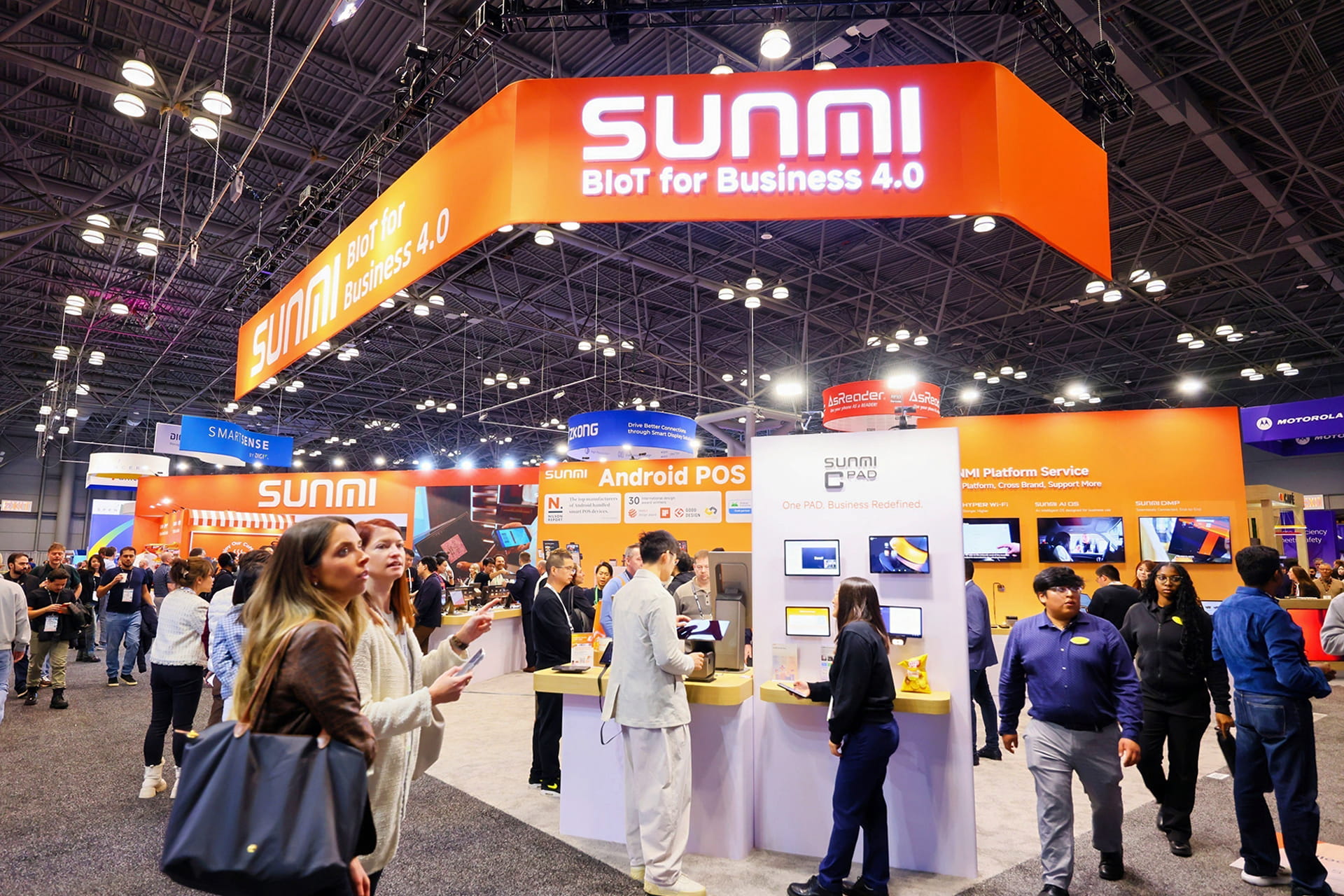
While CES marked a first for Sunmi, the company is a regular presence at NRF and has attended the conference eight times.
At this year’s event, Sunmi partnered with Stripe, Softpay, Google, A. Melville, and Leadin IT Services to host on-site discussions. One of the session highlights was Google recognizing Sunmi as its first Android Enterprise Gold Partner in the Asia Pacific, as well as an ecosystem partner to have obtained AER (Android Enterprise Recommended) certification, Google’s program for endorsing enterprise-grade devices and service providers.
Google said at the event that it will continue working with Sunmi to advance secure and robust Android enterprise services. Currently, only a limited number of companies hold the AER certification, primarily large players such as Samsung and Zebra.
One of the most pronounced differences between China and North America that Sunmi is cognizant of is payment behavior. US consumers continue to rely on card-based systems, including insert, swipe, and NFC tap methods.
Restaurant platform Oddle provides a clear example. After expanding from online-only services into physical locations following the pandemic, it found it inefficient for staff to manage both a tablet and a separate card reader. With Sunmi devices, customers can tap a card or phone directly on the screen. Integration reportedly took about a week, and the company said device-related support requests tend to decline afterward.

Beyond payments, compliance and security remain key barriers in the North American market. Large platforms such as Uber Eats and DoorDash require strict device security standards, highlighting the importance of Sunmi’s Android Enterprise Gold Partner status, which signals that its devices meet Google’s highest compatibility and security requirements. Through Android Enterprise, businesses can manage devices globally while protecting corporate and personal data, with ongoing security updates provided by Google.
In 2024, Sunmi also partnered with Qualcomm to launch what it calls the “Super Solution” dual-system platform, a commercial POS setup running both Windows and Android on Qualcomm chips.
“Many large US retailers still prefer Windows for stability when managing tens of thousands of SKUs,” Zhou said. “Our dual-system approach allows them to switch between both as needed.”
Opening the 100th Sunmi Home outlet
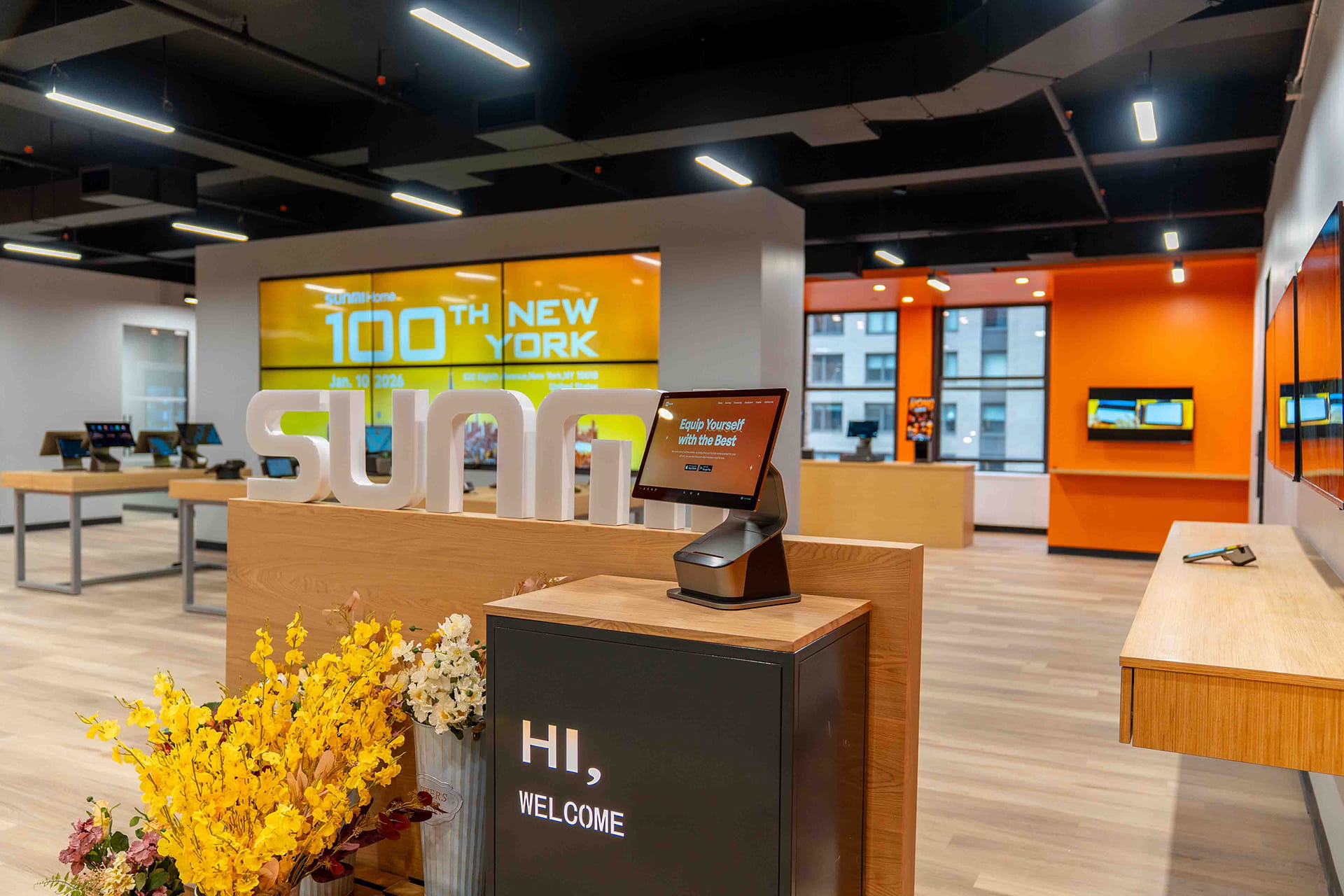
On January 10, in the narrow window between CES and NRF, Sunmi marked its 100th Sunmi Home location with the opening of an outlet in New York.
For companies new to the North American market, issues such as equipment repair, system setup and debugging, and network configuration can create persistent costs, particularly when time zone and language barriers are involved. Built jointly by Sunmi and global partners, Sunmi Home is designed as a centralized hub to address these after-sales challenges.
Each location combines product demonstrations, technical support, and business consulting. The New York outlet will also host in-person events aimed at Chinese restaurateurs and retailers operating locally.
Before the New York opening, Sunmi Home launched its first North American outlet in Atlanta, chosen for its logistics infrastructure and geographic reach.
The focus on North America reflects Sunmi’s effort to balance global strategy with local execution, further expanding its international footprint. As of the end of 2025, the company had established branches in 15 countries across key regions, including the Asia Pacific, Europe, North America, Latin America, and the Middle East and Africa.
The move also reflects a broader view of differentiation. Rather than competing solely on hardware specifications, Sunmi appears to be emphasizing service consistency, shorter repair cycles, and local support. This is reflected in its Sunmi Care warranty service, which the company said covers more than 40 countries through over 100 partner service centers worldwide, providing timely after-sales support across its product lineup.
“To truly take root in a market, products alone are not enough,” Zhou said. “Localization takes time and sustained effort.”
Competing in the next phase of globalization
Individually, Sunmi’s CES debut, NRF presence, and New York expansion may appear distinct. Taken together, however, they show how the company is combining product development, market adaptation, and local service infrastructure into a single globalization push.
That foundation in North America is beginning to resonate beyond the region. Sunmi’s presence in the US, for one, has attracted interest from American brands expanding overseas. Popeyes, for example, has deployed Sunmi’s K2 self-checkout kiosks in parts of China, where facial recognition payments are widely used and therefore essential to support.
The company’s technology has also gained traction elsewhere. In South Korea, Sunmi has partnered with SK Networks and Fastorder to deploy its CPad line in tableside ordering systems. These setups support backend order management and centralized charging and are used by multiple restaurant chains, including South Korea’s largest beer pub franchise, Yeokjeon Grandma’s Beer, which operates more than 1,000 locations nationwide.
Global expansion remains appealing to many companies, but success often hinges on understanding local constraints and investing in long-term standards. Through its recent initiatives, Sunmi signals its intent to position itself not only as a hardware supplier but also as a service partner capable of adapting to market-specific requirements while maintaining operational efficiency.
In markets where infrastructure is often invisible until it fails, that combination may yet prove decisive, offering companies the confidence to expand beyond their home base.
This article was published in partnership with Sunmi.