
Tencent has released and open-sourced HY-World 2.0, its multimodal artificial intelligence system that can generate, reconstruct, and simulate 3D environments from text, images, and video, as the company pushes its Hunyuan model lineup beyond visual content into production-ready assets.
The latest version stands out for its focus on usability. Unlike earlier systems that produced short video clips or static outputs, HY-World 2.0 generates editable 3D assets, supporting formats such as meshes, 3D Gaussian splatting, and point clouds. Those outputs can be exported into game engines including Unity and Unreal Engine, as well as other graphics pipelines, for further development.
Tencent said the model is geared toward real-world workflows, particularly in game development, where teams can use generated environments for map building, level prototyping, and asset pre-production.


The release marks the latest step in a fast-moving iteration cycle for the HY-World series:
- HY-World 1.0, announced in July last year, focused primarily on early-stage 3D scene generation.
- It was followed by HY-World 1.5 last December, which added real-time interaction, allowing users to explore generated environments online.
- With version 2.0, Tencent is shifting toward outputs that can be reused, modified, and integrated into production pipelines.
That progression reflects a nascent trend in generative AI, moving from image and video generation toward structured environments that can function as building blocks for software systems.
Within Tencent’s broader AI strategy, HY-World sits at the top of the Hunyuan ecosystem. While the underlying Hunyuan models handle language understanding and multimodal reasoning, HY-World combines those capabilities with 3D generation and reconstruction into a unified pipeline designed to turn prompts and visual inputs into spatially coherent environments.
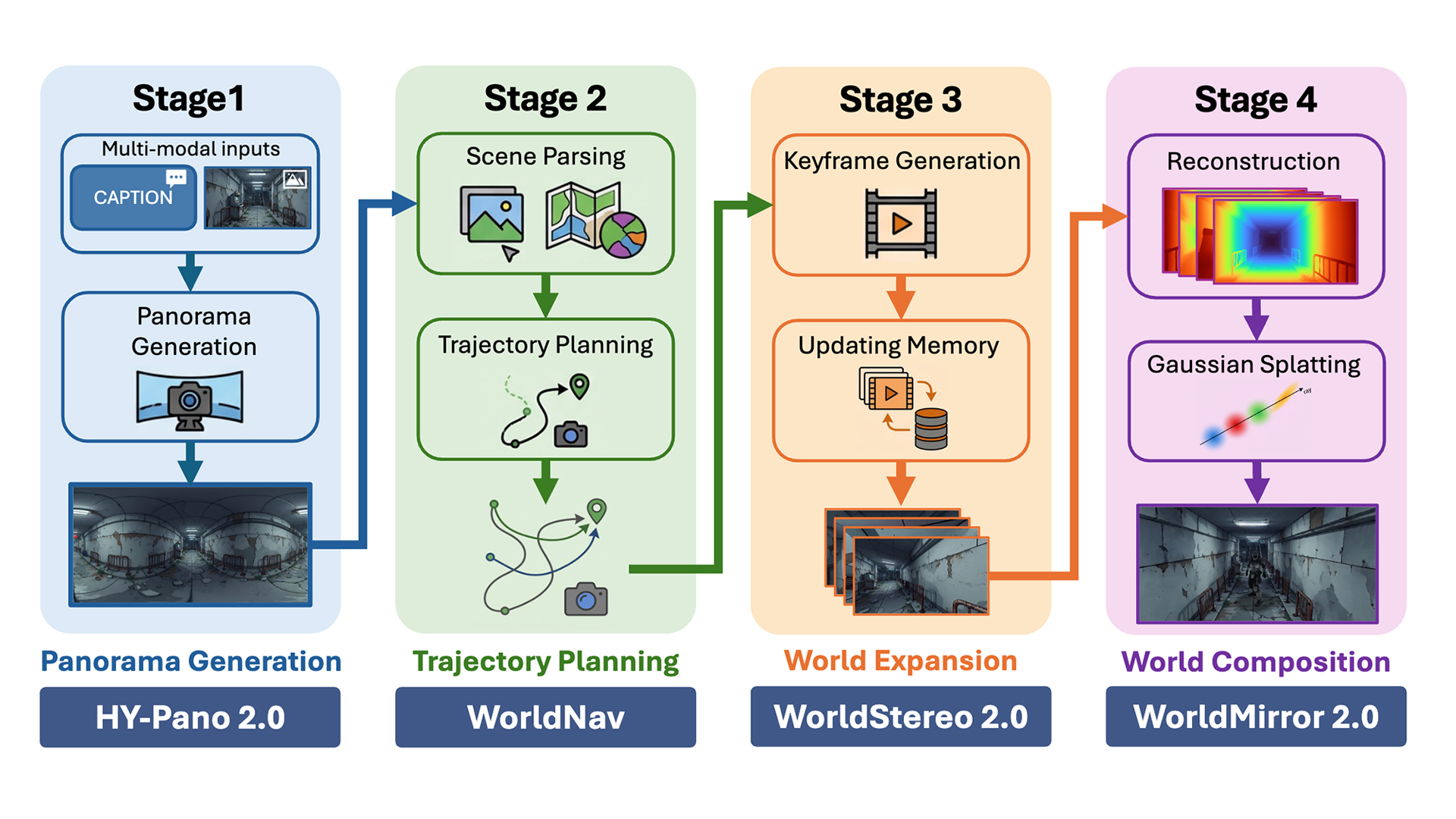
The latest system is structured as a four-stage pipeline:
- HY-Pano-2.0, a panorama model, first generates a 360-degree scene representation from standard images without requiring camera metadata, using a mix of real and synthetic training data.
- A trajectory planning module, WorldNav, then determines how to move through the environment, using spatial reasoning and game-style pathfinding to generate coherent exploration paths while avoiding errors such as clipping.
- Next, WorldStereo 2.0 expands the environment along those paths, maintaining visual detail and spatial consistency as new areas are generated.
- Finally, WorldMirror 2.0 integrates the outputs into a unified 3D environment, producing exportable assets such as 3D Gaussian splatting and meshes.
RELATED ARTICLE

With this release, Tencent said its current focus is on continuing to improve asset quality, reusability, and the reconstruction of real-world environments into digital twins, suggesting future updates will build along the same trajectory.
The company’s emphasis on game development is notable given its scale in the sector. Through Tencent Games and studios including TiMi Studio Group and LightSpeed Studios, Tencent operates one of the largest game production networks globally, comprising titles such as Honor of Kings, PUBG Mobile, and others.
Tencent did not disclose whether HY-World is already being used in specific titles, though the most immediate applications are likely to emerge within development workflows. These include environment and map prototyping, where designers can generate early-stage layouts before refining them, as well as asset pre-production and faster iteration of level designs.
Over time, the technology could extend into live systems, such as environments generated in near real time within games, or tools that allow players to create their own maps using simple prompts. For now, however, HY-World 2.0 appears primarily aimed at reducing the cost and time required to build 3D worlds.