
Willand, the operator of the Segway Navimow brand, has rolled out its one millionth robotic lawn mower. It announced the milestone during a ceremony at its R&D and manufacturing base in Changzhou.
The event was attended by Calvin Chen, Willand’s president and CTO; George Ren, its CEO; and Frank Holzmann, senior vice president at TUV Rheinland.
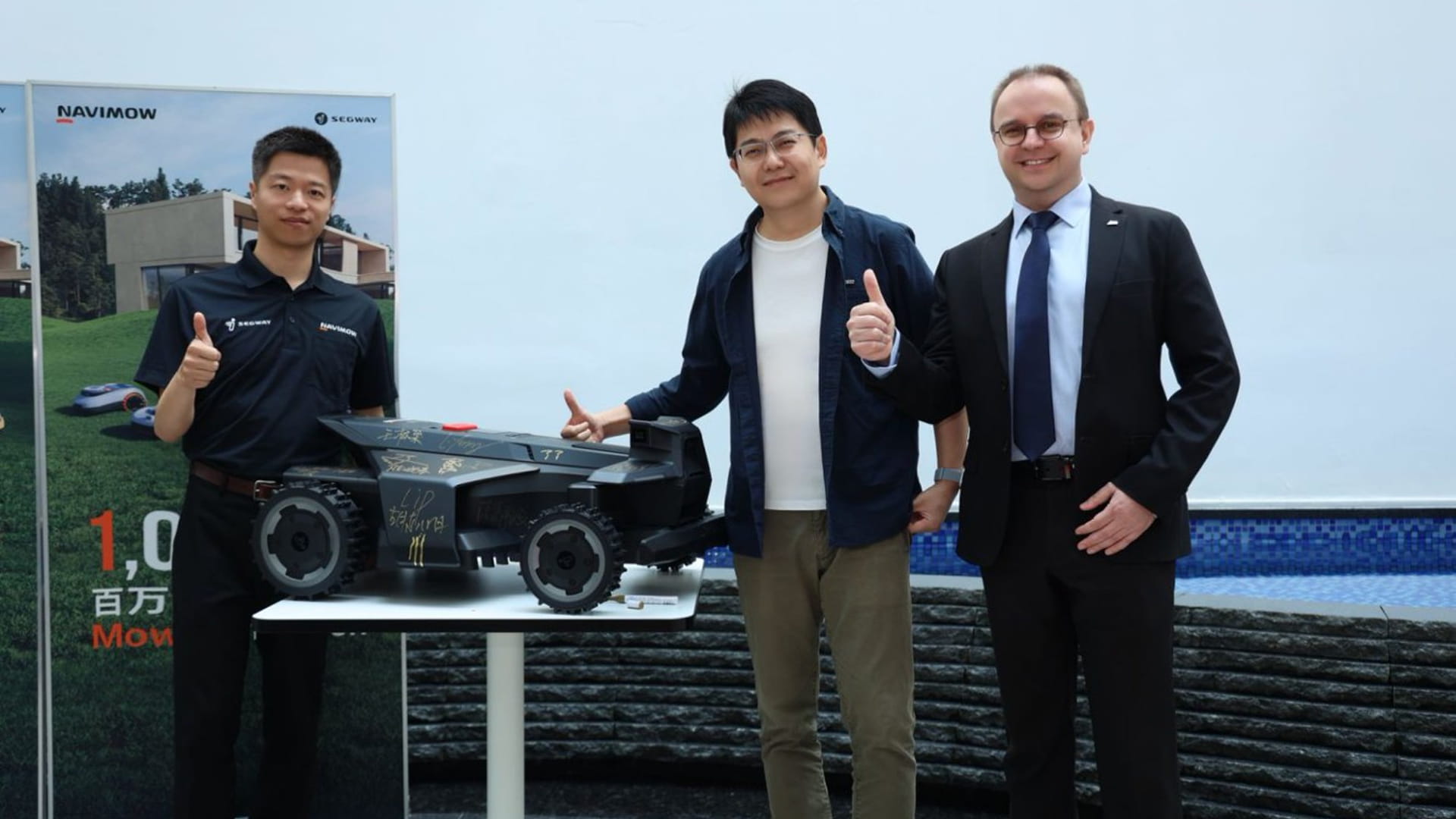
As competition in robotic lawn mowers intensifies, the milestone serves as a checkpoint for Willand’s technology roadmap, supply chain resilience, and global expansion. From launching its first wire-free model in 2021 to surpassing cumulative production of one million units in 2026, the company’s trajectory reflects the broader rise of China’s yard robotics market.
That growth aligns with expanding demand. Data from the China Chamber of Commerce for Import and Export of Machinery and Electronic Products shows China’s lawn mower exports reached RMB 13.2 billion (USD 1.9 billion) from January to July 2025, up 56.6% year-on-year. Global sales of robotic lawn mowers increased 327% year-on-year in the first half of 2025. Within that, wire-free models grew their share from 35% in 2024 to 65%, becoming the primary driver of market growth.
Despite that momentum, the category still faces technical constraints. Robotic lawn mowers are typically expected to perform as durable outdoor equipment, operating reliably across sun, wind, rain, snow, and dust. These expectations bring reliability requirements close to automotive-grade standards. Existing single- and dual-sensor solutions, however, remain limited. Real-time kinematic (RTK) signals can drop under tree cover or near buildings. Vision systems depend on lighting and viewing distance. LiDAR (light detection and ranging) performance, meanwhile, varies based on the availability of environmental features.
As a result, a core user expectation remains largely unmet. While technologies continue to evolve, a fully autonomous, low-intervention user experience is not yet standard.
Willand has focused its product development on four areas: precise positioning, autonomous navigation, obstacle avoidance, and operational efficiency in complex outdoor environments.
In 2026, it introduced EFLSTM LiDAR+, a triple-fusion positioning system developed in-house. Built on solid-state LiDAR and integrated with visual perception and network RTK positioning, the system uses artificial intelligence to process multiple data streams in real time. According to the company, this enables centimeter-level mapping precision and more stable navigation in complex environments, reducing the likelihood of system interruptions.
For obstacle avoidance and safety, Willand developed VisionFence, a visual boundary system that combines 140- to 360-degree wide-angle cameras with time-of-flight sensors and AI algorithms. The system can reportedly identify more than 200 types of obstacles, including suspended objects, with accuracy down to one centimeter. These capabilities are designed to support consistent sensing, positioning, and safety performance across varied conditions.
Willand’s Segway Navimow lineup includes multiple series designed for different yard sizes and use cases, covering residential lawns and larger green spaces, as well as consumer and commercial applications.
Among its products, the X420 and i206 AWD were the first to receive TUV Rheinland’s “Lawn Care” certification. The company’s “Xero-turn” all-wheel-drive system is designed to maintain traction in tight spaces, on steep slopes, and across uneven terrain. During turns, it reduces lateral stress on turf, which may help limit lawn damage.
Product iteration has coincided with commercial expansion. In April, Willand received certification recognizing it as the bestselling brand globally in retail sales of wire-free robotic lawn mowers for two consecutive years. During Amazon Prime Day and Black Friday in 2025, it ranked among the top sellers in its category across six European markets. Its sales network now spans more than 40 countries and regions, with over 5,000 offline retail stores.
According to 36Kr, Willand’s manufacturing bases in Changzhou and Nantong have reached mass production scale. Together with its Malaysia facility, which entered full operation earlier in 2026, these sites form a manufacturing network across China and Malaysia. The company said this footprint supports faster delivery times and greater flexibility in responding to global demand.
KrASIA features translated and adapted content that was originally published by 36Kr. This article was written by Huang Nan for 36Kr.