
Borland, a jeweler specializing in filigree inlay and ancient gold craftsmanship, has closed a Series A funding round, raising more than RMB 100 million (USD 14 million), according to 36Kr. The round was led by Challenjers, with participation from Kering and Shunwei Capital.
The new capital will support four areas: branding, omnichannel retail expansion, supply chain upgrades, and talent investment.
Founded in 1988, Borland has spent nearly four decades advancing traditional imperial Chinese goldsmithing techniques, with a particular emphasis on preserving and modernizing filigree inlay, an intangible cultural heritage craft.
By blending the ritualistic and lineage-driven qualities of jewelry with the tangible detail of artisanal workmanship, Borland has built a reputation in the high-end jewelry market for intricate craft, cultural identity, and emotional resonance.
Rooted in a family of filigree artisans
Ancient gold jewelry is crafted through time-honored casting techniques that create a subtle, matte finish, expressing the restraint central to Eastern aesthetics. Its value lies in its painstaking processes and design language grounded in traditional motifs. Production often takes several times longer than mold-cast modern jewelry.
Within ancient goldmaking, filigree inlay stands as the crown jewel of Beijing’s eight traditional handicrafts, a court art with more than 3,000 years of history. Artisans hammer gold into ultrafine threads and shape them through dozens of delicate steps—pinching, filling, assembling, soldering—transforming hair-thin wires into layered, three-dimensional motifs.
Borland’s identity is closely tied to mastery of this craft. The brand traces its roots to a family of goldsmiths. Its founder began studying the trade as a teenager before moving to Beijing to open a gold workshop, marking the start of the company and embedding within it a distinctly Eastern aesthetic and devotion to craftsmanship. During its Beijing years, the workshop worked closely with national masters and apprentices in the filigree tradition, now recognized as holders of intangible cultural heritage status.
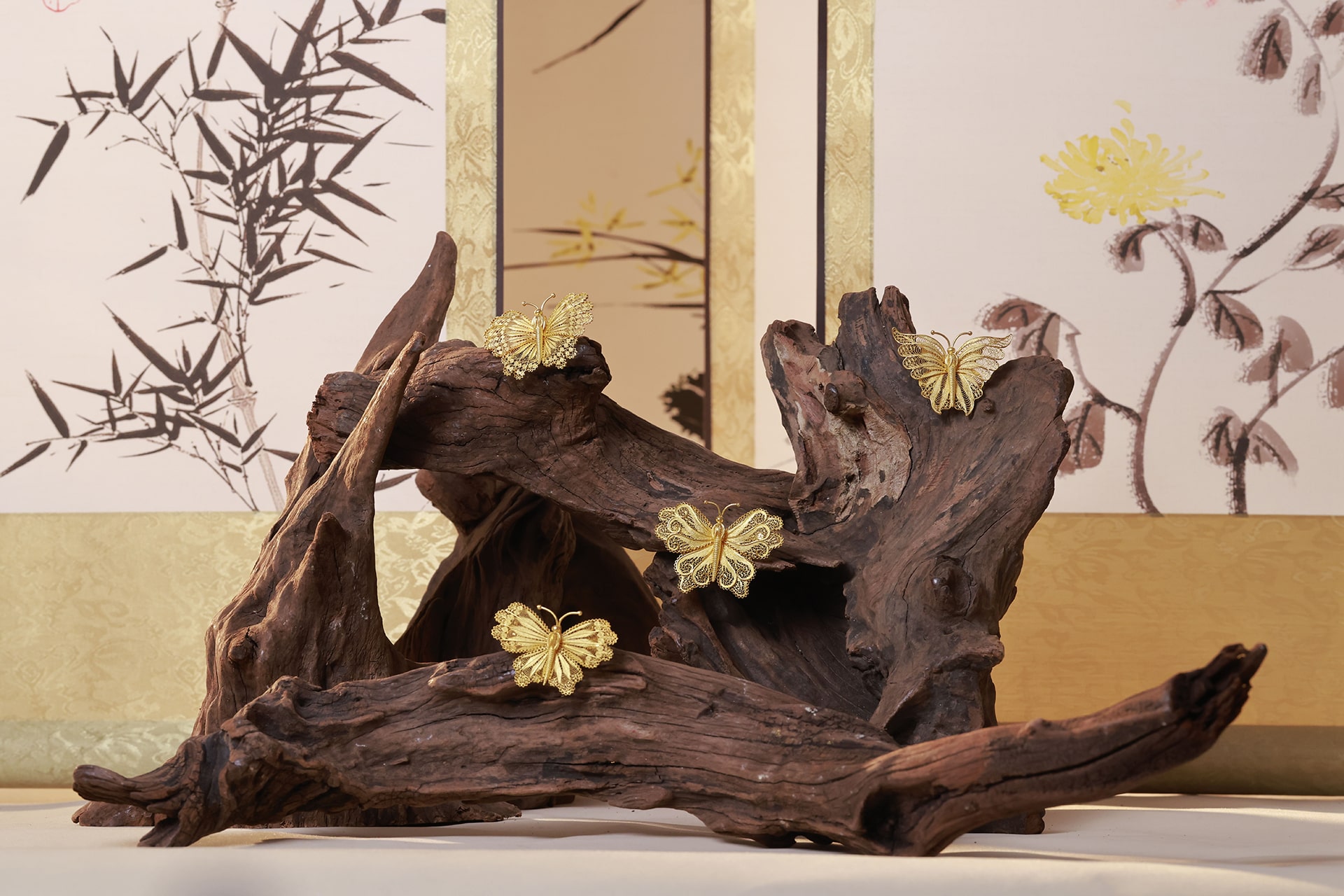
Many of Borland’s designs draw inspiration from classic Chinese motifs and objects. One collection features pendants with filigree brooches in symmetrical butterfly forms, symbolizing balance and the yin-yang harmony of feng shui. Another, inspired by the Baoxiang floral pattern, conveys prosperity, purity, and dignity. The brand also offers earrings modeled after the ridged structure of traditional palace lanterns, expressing wishes for peace and blessings.
Gold’s new narrative
According to the China Gold Association, China’s gold jewelry consumption fell 25% year-on-year in 2024, yet the ancient gold segment continued to grow. Among the well-known players, Laopu Gold saw revenue surge 251% year-on-year to RMB 12.35 billion (USD 1.73 billion) in the first half of 2025, with per-store sales outpacing some international luxury houses.
Ancient gold techniques have moved from niche to mainstream, reshaping consumer perceptions. Once tied primarily to weddings and gifting, gold jewelry now conveys personal expression and fashion identity, even serving as a form of social currency. As a result, pieces with finer craft and deeper cultural content are attracting a wider audience.
For most of its history, Borland remained relatively low-profile, though its sense of luxury has always been apparent. At an appraisal and showcase event held in Shanghai in January 2019, Borland was the only jewelry brand invited to exhibit alongside watchmakers such as Vacheron Constantin and Jaeger-LeCoultre. Several of the designs displayed then remain bestsellers today.
Unlike peers that have expanded aggressively offline, Borland has taken a deliberate approach. Its first boutique opened in Hangzhou Tower, followed by a second at MixC Hangzhou in June 2020, accompanied by a nationwide limited release of thirty filigree golden arowana sculptures. Only in March this year did the brand open its first store outside the region, at MixC Shenzhen, marking its entry into southern China.
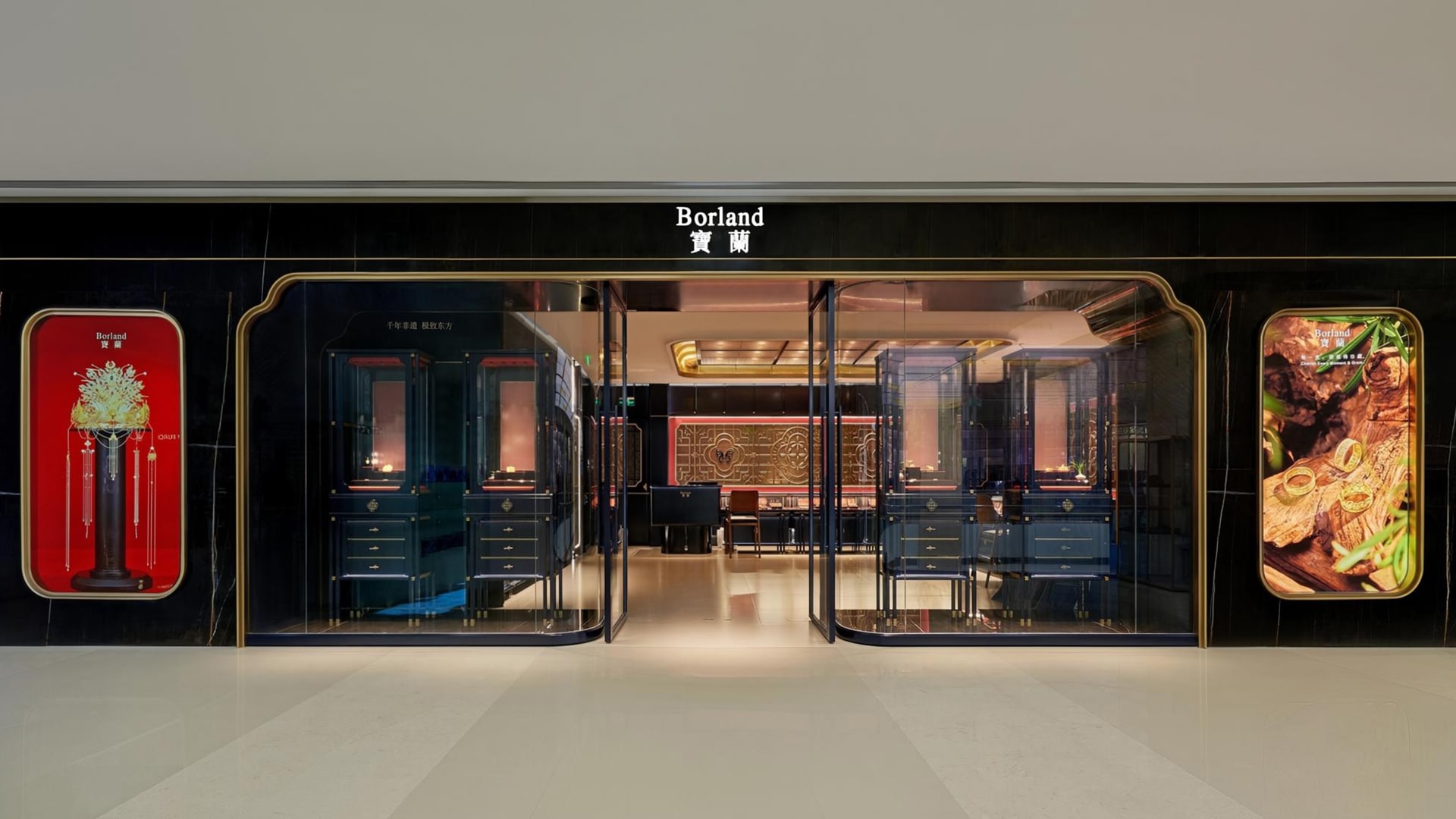
As global luxury brands turn their attention to the East, China is shaping the next chapter of luxury. Like several high-end jewelry brands now gaining visibility, Borland differentiates itself through exceptional craftsmanship. On social media, buyers describe its works as “delicate,” “artistic,” and “collectible.”
From a scale perspective, Borland’s retail footprint and brand development still have considerable room to grow, and that, perhaps, defines its next horizon.
KrASIA Connection features translated and adapted content that was originally published by 36Kr. This article was written by Ren Cairu for 36Kr.