
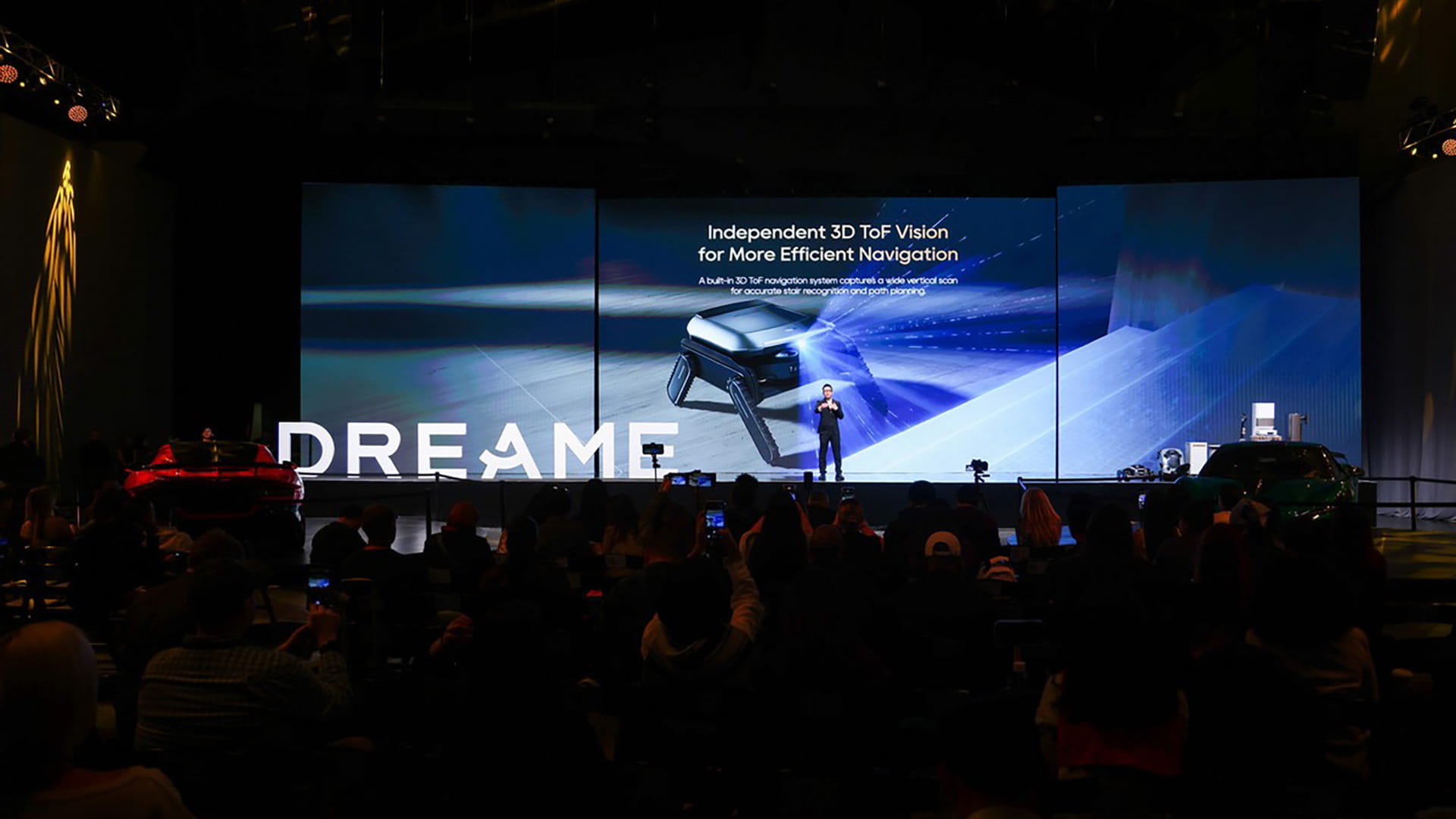
On April 27, the Palace of Fine Arts in San Francisco, a century-old US landmark, became the site of a technology launch.
Dreame opened its global launch week at the venue, where two rocket boosters protruded from the rear of a red supercar. The vehicle, called the Nebula Next 01 Jet Edition, was the centerpiece of Dreame’s Nebula Next program.
The car is equipped with a custom rocket-based booster system that Dreame said can deliver an instantaneous response in 150 milliseconds and peak thrust of 100 kilonewtons, close to the thrust of a single Boeing 737 engine. The company said the vehicle can accelerate from zero to 100 kilometers per hour in 0.9 seconds.
Dreame also unveiled the DHX1, a flagship LiDAR (light detection and ranging) system; its first production-ready all-solid-state battery; a fully steer-by-wire chassis; and other technologies that make up the Nebula Next technology system, a 12-part stack.
Dreame’s move into cars was years in the making
China’s automotive sector is going through another upgrade cycle. Chinese new energy vehicle (NEV) makers are already among the world’s leaders in manufacturing capability and smart features, but the most intense competition remains largely domestic. Chinese brands have yet to make a clear breakthrough in the global high-end segment.
The global high-end NEV market still presents opportunities. Traditional luxury brands have moved cautiously in electrification, while emerging brands have yet to establish a firm benchmark. This is the opening Dreame is trying to enter through technology.
Automotives, however, are complex products. To compete at the top of the global market, software and hardware capabilities are only the entry point. The more important question is whether a company can create a new path and introduce new definitions of technology and product.
Dreame’s arrival is an attempt to answer that question.
Since its founding, Dreame has held to one core belief: technology is the foundation of its products. When founder Yu Hao established the company, he made clear that its products had to possess meaningful technological barriers. Its first project was to develop a digital motor that could reach 100,000 revolutions per minute, putting it among the best in the world at the time.
The high-speed motors used in smart cleaning devices and the electric drive motors used in NEVs share a similar technical foundation. Both require efficient conversion of electric energy and precise power control, and both must meet demanding requirements for stability under high-load mass production.
Power performance has long been a marker of the high-end market. It is also one of the harder problems in technology development.
Compared with gasoline engines, electric drive motors have lowered the threshold for acceleration performance in mass market vehicles. For example, some RMB 100,000-level products can accelerate from zero to 100 kilometers per hour in eight seconds or even six seconds. But power performance in ultra-high-end vehicles still presents significant technical challenges.
The challenge in developing drive motors lies in pushing the physical limits of materials at ultra high speeds while maintaining stability and efficiency.
Dreame has spent a decade developing electric motors. It has made progress in areas such as aerodynamics, electromagnetics, drive systems, and power electronics, while accumulating experience in mass production challenges including dynamic balancing, vibration damping, noise reduction, and thermal design. While electric motors from international manufacturers generally operate at around 125,000 revolutions per minute, Dreame said it has pushed that figure past 200,000.
Dreame’s investment in core technology also extends beyond high-speed motors. It has been building capabilities in frontier areas such as algorithms, bionic robotic arms, and all-domain chips.
The overlap between these technologies, combined with years of accumulated work, helps explain why Dreame’s move into cars was not abrupt.
RELATED ARTICLE
Dreame’s bet is broader than technology
Over more than a century of automotive history, industry benchmarks have often been set by companies that redefined the core concept of the vehicle and opened new development tracks. Mercedes-Benz helped lay the foundation for the modern car through early mechanical architecture. Tesla helped define the logic of NEV manufacturing through a minimalist intelligent cockpit and software-centered vehicle design.
Dreame is not the only company capable of developing ultra-high-speed drive motors. Yet it is among the few trying to apply such technology to the complex environment of smart vehicles. The key lies not only in sustained investment, but also in how the company understands technology and reads market demand.
The potential value of Dreame’s new car lies in its attempt to step outside the established paradigm. Is the limit of acceleration from zero to 100 kilometers per hour really around two seconds? Must propulsion be a choice between gasoline and pure electric power? For Dreame, which has built capabilities in electric motors and rocket booster technology, the answer may be more open-ended.
That is also where technological innovation seems to be heading: integration and breakthrough. The automotive sector is not asset-light. Moving a product smoothly from design to mass production has long been a challenge for Chinese automakers. As a result, much of their energy has gone into production and manufacturing, often limiting sustained investment in core technologies.
As manufacturing capability improves across the sector, attention is shifting back to core technology. Only through technological breakthroughs can companies open new room for growth.
That is the role Dreame is trying to play. As a long-term participant in consumer electronics, it is combining its understanding of technology with market insight as it enters the automotive sector at a critical point in its upgrade cycle.
Vision alone, however, is not enough. Building cars requires engineering execution. Dreame’s effort is testing the full chain from technology to product, and from market insight to implementation.
In perception, Dreame’s Nebula Next program worked with global core partners to develop and launch the DHX1, a system based on its 6D full-color 1,000-line LiDAR platform. Dreame said the system can simultaneously perceive XYZ coordinates in 3D space and RGB color information from objects, directly generating native color point clouds.
The DHX1 supports up to 4,320-line full-color 4K ultra-high-definition perception, with a maximum detection range of 600 meters, according to Dreame. Even at 10% reflectivity, its detection range reportedly reaches 400 meters. Dreame said it can identify small targets such as water-filled traffic barriers within 300 meters and small animals within 280 meters, and recognize traffic lights, lane markings, and small objects with precision.
In chassis control, Dreame offers a system that combines fully steer-by-wire technology with artificial intelligence-powered coordination. The company said this setup breaks through the limits of traditional mechanical control, allowing the rocket car to balance extreme acceleration with driving stability. In power and range, Dreame said its all-solid-state battery, paired with integrated packaging technology, addresses current energy pain points in NEVs.
The third leap for Chinese new energy vehicles
After more than a decade of rapid development, China’s NEV sector has gone through two major rounds of iteration among its new automakers.
The first generation of new automakers was represented by Tesla, Nio, Li Auto, and Xpeng. These companies helped move NEVs from concept to scaled mass production.
The second generation is represented by the Harmony Intelligent Mobility Alliance (HIMA). Its goal is not to build cars directly or invest heavily in full-vehicle assets, but to rely on technology R&D strengths and support automakers in areas such as intelligent cockpits, driving assistance, and in-vehicle ecosystems. In doing so, it has helped NEVs move from affordability toward the high end.
The debut of Dreame’s Nebula Next program and car may point to the emergence of a third generation of new automakers.
After years of development, China has formed one of the world’s most complete NEV industrial systems. Upstream core components, midstream vehicle manufacturing, and downstream ecosystem support have all reached a high degree of domestic control. These capabilities provide the basic conditions needed to challenge the global high-end segment. But entering that market also requires breakthroughs in original technology, brand building, and global operations.
Dreame is trying to carry forward the advantages of the first two generations in deep technology development, while avoiding both asset-driven competition and the limits of software-based empowerment. Drawing on years of experience in consumer electronics and smart hardware, it has built capabilities across electric drive systems, perception, algorithms, and multi-category hardware integration. It has also been developing what it describes as an integrated human-vehicle-home technology ecosystem.
From this perspective, the new car is less a sudden turn toward carmaking than a milestone in Dreame’s public display of its technological capabilities. The message is straightforward: Dreame is not starting from scratch. It has a foundation built over years, even if that expertise was not accumulated directly in the automotive sector.
KrASIA features translated and adapted content that was originally published by 36Kr. This article was written by 36Kr Auto.
Note: RMB figures are converted to USD at rates of RMB 6.79 = USD 1 based on estimates as of June 5, 2026, unless otherwise stated. USD conversions are presented for ease of reference and may not fully match prevailing exchange rates.