
China is home to the world’s largest electric vehicle makers and is also widely known for how competitive the market is. In the early buildout of the sector, it became notorious for the shakeout that followed a wave of new entrants hoping to capitalize on the opportunity created by Beijing’s push for electrification.
Subsidies played a central role. In 2009, China began rolling out financial subsidies and tax breaks for both EV producers and consumers, starting with pilot cities before expanding the program more broadly. These measures varied by city depending on local needs. The system only began to shift in 2018, when a market-based vehicle credit program targeting zero-emission vehicles was introduced. The rebates were then gradually phased out before ending after 2022.
According to the Center for Strategic & International Studies, the Chinese government is estimated to have committed nearly USD 230.9 billion in financial support between 2009–2023 to the broader program, spanning EV purchase rebates, tax exemptions, charging infrastructure, R&D programs, and government procurement.
In hindsight, one consequence of this policy arc is clear: intense consolidation. Many players exited the sector, or lost momentum, after realizing amid price wars that they could not become competitive enough or build a sufficiently lucrative business without relying on subsidies.
Consider HiPhi, which has suspended production since 2024, or Hozon Auto, which filed for bankruptcy after running into financial difficulties, despite its Neta EV brand performing relatively well in Thailand, its strongest market. Then there are many others, such as Qiantu Motor, that have folded altogether.
AlixPartners estimates that consolidation will continue if the sector stays on its current trajectory. Of the 129 players it identified in China’s new energy vehicle (NEV) market, it forecasts that only 15 will attain financial viability by 2030, capturing about 75% of total market share.
That appears consistent with the current sector’s direction. Of the companies that have endured, only a handful have found sustainable profitability, with BYD leading the pack, while peers such as Geely and SAIC Motor have either reached or moved closer to their profit targets.
More broadly, however, the more interesting takeaway is this: If Chinese automakers are not yet good at making money, how should the steadily expanding global footprint of Chinese-made EVs be explained?
Judge them as carmakers first, EV makers second
China accounts for nearly two-thirds of all electric cars shipped globally, according to 2024 estimates from the International Energy Agency (IEA) and the China Passenger Car Association, which uses the NEV metric. But that headline figure needs a more granular reading to explain the ongoing overseas push despite relatively weak profitability.
On conventional business fundamentals, expansion typically follows a position of strength, including stable profitability and markets with visible room for growth. High market share paired with low profitability gives a less favorable impression to investors.
There are two things to note here.
First, vehicle electrification remains an uneven trend, shaped heavily by policy, among other factors.
Second, in the eyes of Chinese carmakers, success in the domestic market may not always be viewed as a prerequisite for international expansion. Instead, domestic and overseas markets may be pursued at the same time in an effort to achieve a better overall business mix.
In practice, that means that alongside selling EVs at home, many Chinese automakers are also shipping vehicles abroad to different markets depending on their more immediate needs. That also means that, beyond pure EVs, other vehicle types remain relevant.
Some regions may want to embrace electrification but still lack the infrastructure or means, whether political or socioeconomic, to support meaningful EV adoption. Others simply do not yet treat vehicle electrification as a policy priority. Faced with such markets, Chinese automakers have two options: wait until those markets are ready for EVs, or sell them something else. In many cases, they are choosing the latter, because it brings in revenue and capital that can support the broader business.
In South Africa, for instance, Reuters reported, citing data from research platform Jato Dynamics, that Chinese automakers accounted for nearly 16% of the market in the first half of 2025, up from 10% a year earlier, driven largely by gasoline vehicle sales.
That aligns with findings from consulting firm Automobility, which estimates that eight of the top ten passenger car manufacturers in China still derive most of their international sales from gasoline-powered models, based on data collected between January and October 2025.
Automobility also estimates that gasoline vehicles have accounted for at least 76% of Chinese car exports since 2020, with total shipments in 2025 likely exceeding 6.5 million units. Chery and Geely, both major names in China’s EV sector, are among the companies that fall into this category, selling more gasoline vehicles than other types despite the clear shift in industry discussion toward EV sales and adoption in recent years.
It is therefore unsurprising that China is not only the world’s largest exporter of EVs, but of cars overall, having overtaken former leader Japan in 2023, according to the International Trade Council.
That is not to say EVs do not feature in global plans, but rather that Chinese automakers appear to recognize that one-size-fits-all strategies are unlikely to work well. In Europe, where electrification is advancing under a broader sustainability agenda, plug-in hybrid cars feature more prominently in export strategies because they face only the base import tariff of 10%, below the additional duties on imported full EVs, which can rise to about 35%.
Policies shaping the trajectory of EV exports extend beyond tariffs and duties. To protect local or incumbent players, some countries are also pressing exporters to commit resources to building local industry and infrastructure. BYD is one example. In addition to opening factories and R&D centers in Brazil and Hungary last year, the company has established overseas component warehouses in places such as the Netherlands, partly to support after-sales operations and partly to build up activity on the ground.
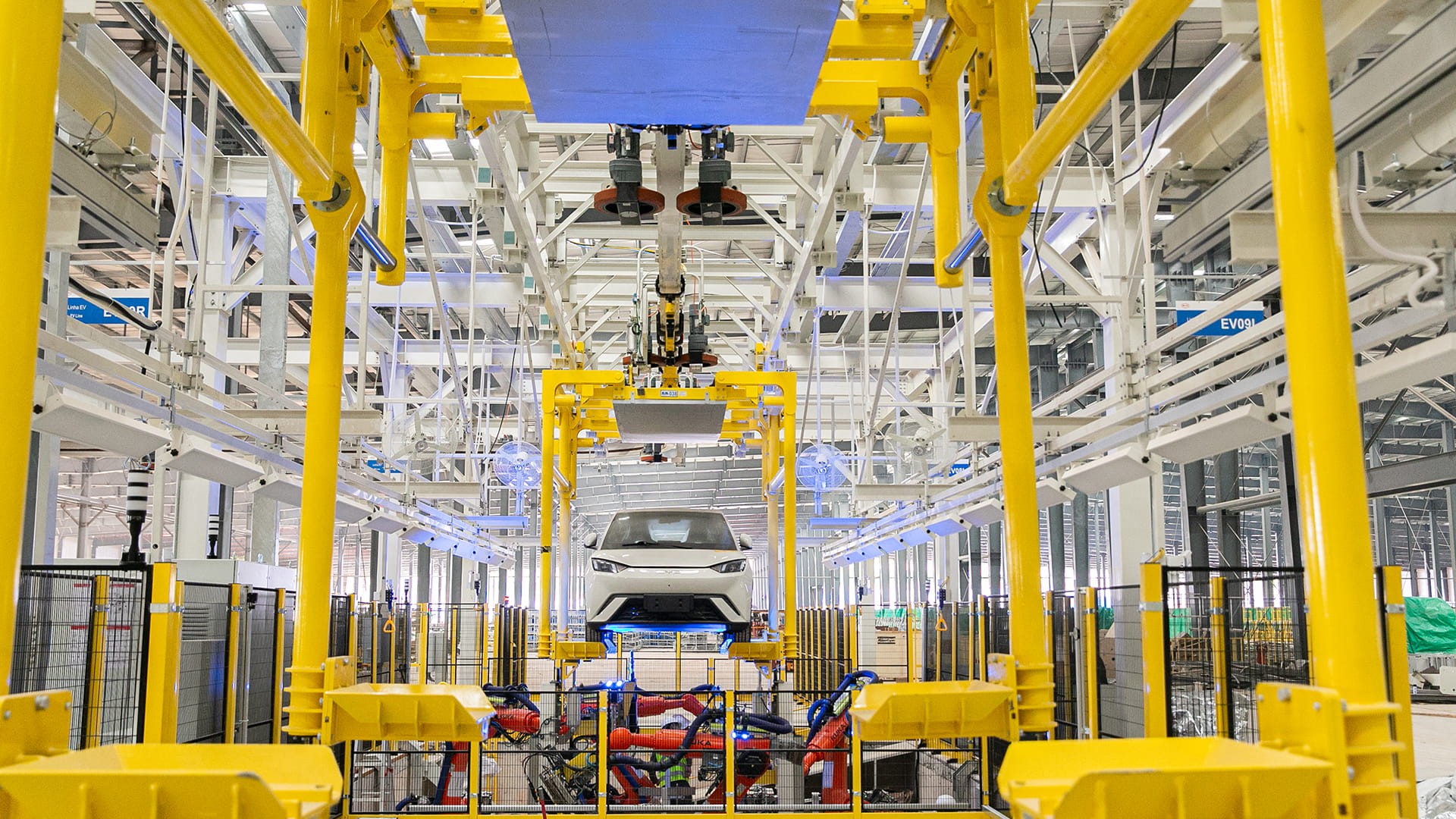
Factories, which contribute more directly to local economies than imported vehicles do, also feature heavily in these strategies. BYD, along with Chery and Great Wall Motor, has factories operating or in development in Brazil, the largest automotive market in Latin America and a fast-emerging EV market.
US-based consulting firm Rhodium Group found that, for the first time since records began in 2014, the Chinese EV supply chain invested more outside China than at home. About 74% of that investment went to battery factories, Rhodium wrote. Meanwhile, domestic EV manufacturing investment fell to USD 15 billion in 2024, down from USD 41 billion in 2023. That figure had previously peaked at more than USD 90 billion in 2022, based on announced projects.
Taken together, these observations suggest that Chinese automakers are increasingly deploying a diversified strategy as they expand globally: matching products to local demand and lowering barriers to entry where possible. That means shipping EVs to markets seen as accessible and capable of supporting demand, building local production capacity or adjusting to policy requirements in more industry-sensitive markets, and relying on legacy vehicle types, including gasoline models, in markets not yet ready to embrace electrification.
Viewed from this angle, the current discourse seems overly focused on the near-term profitmaking ability of EVs among Chinese automakers and less focused on the moat still being built and the health of the broader business.
Chinese EV players have built an enormous international footprint on a percentage basis despite foreign protectionist policies, uneven EV market development globally, and competition from both Chinese and international peers.
One potentially supportive development is that policy can change. There have already been signs of that, with markets such as Canada signaling a greater willingness to engage with Chinese EV makers, subject to mutually beneficial terms. Under Prime Minister Mark Carney, the country announced in January that it would cut tariffs on up to 49,000 Chinese EV units from the previous 100% to a preferred rate of 6.1% as part of a new bilateral partnership tied to Chinese investment in Canadian production.
Meanwhile, the diversified strategy appears to be helping companies navigate uneven EV market development abroad, serving EV demand where it exists while also supplying other vehicle types in markets that are not yet ready. That, in turn, may help build brand awareness in advance of future EV demand.
Less competition abroad than at home
As for competition, aside from Tesla, few international players operate at comparable scale. Most are legacy automakers from Europe and Japan. Many now work with Chinese companies, either directly with carmakers or through supply chain partnerships, as global manufacturing increasingly shifts beyond national lines to focus on material sourcing, production efficiency, and economies of scale. In this context, China holds a commanding position, with significant control over rare earth materials, a strong foothold in battery production, particularly through Contemporary Amperex Technology (CATL), and deep supply chain expertise built over time.
RELATED ARTICLE

The argument, then, is whether investors may be putting too much weight on conditions in China and extrapolating them too directly to the opportunities available to Chinese EV makers abroad.
The reality is that, unlike China, which already has a relatively mature EV sector, many overseas markets still offer substantial room for growth, even if that opportunity is unevenly distributed. Vehicle electrification is expected to remain a policy priority for many countries, particularly as recent geopolitical conflict puts additional pressure on oil supply. And, Chinese carmakers aside, there are relatively few competitors ready to meet the demand expected to build in the years ahead.
As one snapshot, the IEA forecasts that EVs will account for at least 25% of cars sold in Southeast Asia by 2030, up 16 percentage points from 2024. The buildout needed to support that demand is already underway, with facilities opening in countries such as Vietnam.
Elsewhere in Europe, CNBC reported that Chinese-owned car brands accounted for 10% of all new car sales in the UK in June 2025, up sharply from previous years after tapping into rising Chinese EV sales. In Norway, Chinese EV brands reportedly captured about 10% of market share on a combined basis. That traction has come despite continued sensitivity in European markets toward EVs from China, with critics arguing that state support has given Chinese EV players an unfair advantage over international rivals.