
Xiaomi is expanding its YU7 lineup as it tries to cover more of China’s increasingly crowded electric vehicle market.
On May 21, it introduced two new YU7 variants: a standard version starting at RMB 233,500 (USD 34,330.2) and the YU7 GT starting at RMB 389,900 (USD 57,324.7). The additions expand the YU7 family to five models, with prices ranging from RMB 233,500–389,900 (USD 34,330.2–57,324.7).
YU7 is Xiaomi’s first SUV and was launched in June 2025. According to the company, confirmed orders exceeded 200,000 within three minutes of launch. At the latest event, Xiaomi founder Lei Jun compared the model’s performance with Tesla’s Model Y, saying YU7 delivered 232,000 units from July 2025 through April 2026, compared with 358,000 units for Model Y over the same period.
In January, YU7 deliveries reached 37,869 units, making it the bestselling model across China’s passenger vehicle market that month, according to Xiaomi. Deliveries have since softened as competition has intensified.
RELATED ARTICLE
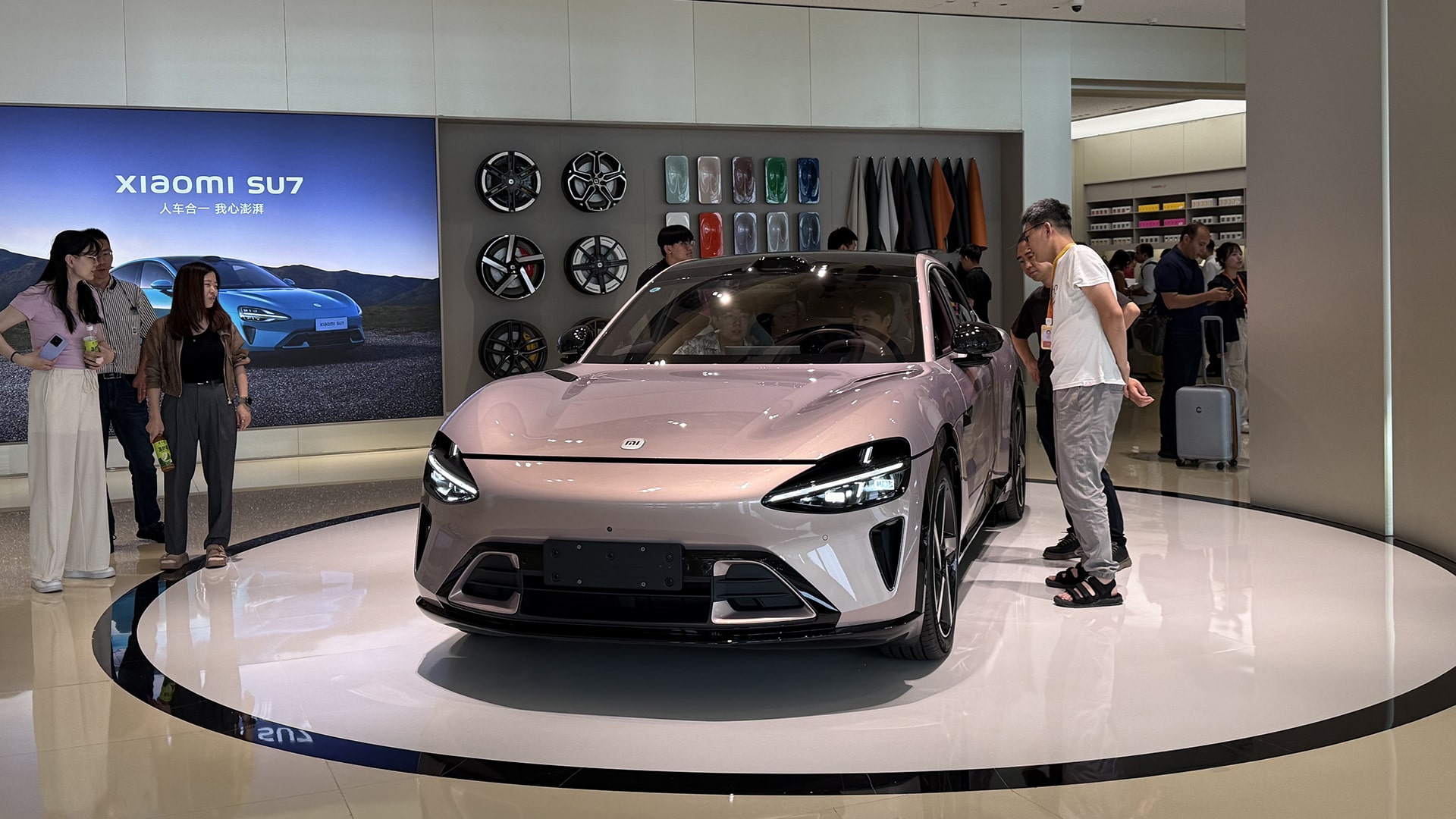
The new standard version appears designed to close one gap in Xiaomi’s contest with Tesla. In Xiaomi’s research, roughly 70% of Model Y orders were for the rear-wheel-drive standard version with 593 kilometers of range. For many users, Lei said, a range of 500–600 kilometers is sufficient for daily commuting, while Tesla’s five-year, interest-free financing offer has also proved attractive. Some users viewed the policy as equivalent to a direct RMB 20,000 (USD 2,940.5) discount.
Lei added that Xiaomi had originally planned a similar rear-wheel-drive standard version for YU7, but later removed it as the company tried to simplify the lineup.
“To be honest, we thought our product line was too complicated, so we reduced it from four versions to three and removed the standard version,” Lei said. “That was especially unfavorable for YU7’s competition with Model Y.”
After reviewing the decision, Xiaomi chose to restore the standard version. Lei said the revised lineup allows Xiaomi to match standard versions against standard versions and long-range versions against long-range versions. “No matter how Tesla offers five-year, zero-interest financing, we have absolute competitiveness,” he said.
The standard YU7’s starting price is RMB 20,000 lower than the previous entry point and RMB 30,000 (USD 4,410.7) below Model Y’s, according to Xiaomi. Its main differences from higher-end YU7 trims are the battery and the absence of continuously variable damping control.
The other new model, YU7 GT, is positioned as a full-powered grand tourer. During a media briefing after the launch, Lei described the differences among YU7, YU7 GT, and Xiaomi’s Ultra models.
“[The YU7] is a driver’s car, but it also has to be suitable for family and everyday use,” Lei said. “[The GT] needs sports car-level styling and performance, while also being suitable for daily travel and commuting. It is an all-round model.”
Where the standard YU7 directly targets Model Y, Lei said YU7 GT is aimed more at customers who previously bought from high-end brands such as BMW, Mercedes-Benz, and Audi.
Another key part of YU7 GT’s positioning is Xiaomi’s German R&D team. According to the company, it recruited talent from automakers including BMW and Porsche to form the team, which helped YU7 GT record what Xiaomi described as the fastest SUV lap time on the Nurburgring Nordschleife.
From SU7 Ultra to YU7 GT, Xiaomi has repeatedly used the Nürburgring as a proving ground. Hu Zhengnan, CTO of Xiaomi’s EV business, told 36Kr and other media outlets that running laps there is “a method, not a goal.”
“When we first proposed going [to the Nurburgring], the engineering team opposed it,” Hu said, citing the lack of experience.
He said Xiaomi persisted partly because the circuit helps engineers identify shortcomings in vehicle dynamics and overall performance. More importantly, Hu said, Xiaomi wants to enter global markets and needs to compete with leading global companies on a platform that overseas users and industry peers understand.
According to Lei, Xiaomi has built an automotive R&D team of nearly 10,000 people over the past five years, including around 1,500 engineers with 15–20 years of carmaking experience. Total investment has approached RMB 30 billion (USD 4.4 billion). When Xiaomi announced its carmaking plan in 2021, Lei pledged to invest USD 10 billion over ten years.
Production is another test. Song Gang, vice president and chief of staff of Xiaomi’s EV business, made his first public appearance at the media briefing after the company recently disclosed his role. Song previously worked at SAIC General Motors, Ford, Tesla, and Envision Energy. Under his leadership, Tesla’s Shanghai plant became known for its speed from groundbreaking to mass production and delivery.
Production and delivery constraints have been among Xiaomi’s biggest challenges over the past two years. When YU7 launched, estimated delivery times stretched as far as 36 months. Song said production and delivery capacity had materially limited YU7’s ability to capture more orders.
“Over the past year, the sales, supply chain, and production teams have all worked very hard and done a lot,” Song said. “We have pushed production preparation to the limit and moved all preparation work forward. The speed and quality of the supply chain ramp-up are very fast, and Xiaomi itself now has good production efficiency.”
Lei added that YU7’s current delivery cycle has been shortened to two to three months, while cities with existing inventory can complete delivery in as little as two hours. Even the YU7 GT, which is more difficult to manufacture, can be delivered within six weeks, he said.
By adding a standard version to challenge Model Y and a GT version aimed at legacy luxury buyers, Xiaomi is trying to stretch YU7 across a broader set of consumers. Its Nürburgring push and European R&D buildout also point to its global ambitions.
The challenge is that Xiaomi is trying to do several difficult things at once: expand scale, move upmarket, and prepare for international competition. That will keep pressure on its R&D, cost control, brand positioning, and supply chain.
The following transcript has been edited and consolidated for brevity and clarity.
36Kr: How does the standard and GT version of the YU7 differ in terms of positioning and target customers?
Lei Jun (LJ): We previously described the Xiaomi YU7 as a high-performance luxury SUV. It is a driver’s car, but it also has to be suitable for family and everyday use, and it must offer luxury and comfort.
GT is the flagship performance model in the YU7 series. Its positioning is that of a full-powered GT. It needs sports car-level styling and performance, while also being suitable for daily travel and commuting. It is an all-round model.
GT is also different from Ultra. Ultra is positioned as a race car and sports car. You can use it for commuting, but more importantly, it is a sports car.
Our user research shows that GT mainly attracts people who previously bought luxury vehicles from BMW, Mercedes-Benz, and Audi. They want strong power but also want a car that can be used for commuting, long-distance travel, and family needs. GT is a dream car designed for this group.
36Kr: Why did Xiaomi choose this moment to bring back the YU7 standard version?
LJ: Our research found that 70% of Model Y users chose the 593-kilometer version. Many users think 500–600 kilometers is already enough for daily commuting.
To be honest, we thought our product line was too complicated, so we reduced it from four versions to three and removed the standard version. That was especially unfavorable in YU7’s competition with Model Y. After reviewing the decision, we brought the standard version back. That lets us match standard version against standard version and long-range version against long-range version. No matter how Tesla offers five-year, zero-interest financing, we have absolute competitiveness.
36Kr: Xiaomi no longer discloses gross order figures, and last month’s delivery figure was lower than the number disclosed by the China Passenger Car Association. Thoughts?
LJ: When YU7 was released last year, confirmed orders exceeded 200,000 within three minutes. The number was so surprising that almost no one in the industry believed it. Many thought there was something wrong with our data. Later, I decided we should disclose only locked-in orders and focus on the volume with nonrefundable commitments. We will disclose only locked-in orders from now on.
As for monthly deliveries, I do not want to get caught up in comparisons. I think it is fine to be roughly accurate. When the team asks me before publishing a number and says it is 36,700 units, I tell them to just state it as 30,000. The difference is not material.
Xiaomi needs to stay calm. Carmaking is a ten-year effort. There is no need to fight over one month’s ranking. If we build good cars and serve consumers well, step by step, Xiaomi can become one of the world’s top five automakers. Whether we deliver one more or one fewer vehicle today is not important.
36Kr: Xiaomi’s European team includes many senior experts. How did Xiaomi recruit this level of talent?
LJ: We thought about setting up a European R&D center for a year.
Why did we need a European R&D center? Xiaomi’s smart ecosystem is already part of every Xiaomi car. What we need to strengthen in carmaking is performance, safety, and quality. These are core capabilities. Europe has deep strengths in mechanical quality, so we want to attract global technical experts and do this seriously.
I personally took part in interviews for all key positions. Our R&D department now includes about 1,500 technical experts with 15–20 years of experience.
36Kr: Xiaomi again announced a Nürburgring record. What is Xiaomi trying to prove by continuing to run laps there?
Hu Zhengnan (HZ): Going to the Nürburgring is not about proving something. In one sentence, it is a method, not a goal.
When we first proposed going there, the engineering team opposed it. First, we truly had no experience in how to achieve good results at the Nürburgring. The team was also worried about what would happen if we failed, so engineers initially preferred a safer approach.
But after thinking through several questions, we decided the direction was right. For high-performance cars, the Nürburgring is a testing ground. Almost all high-performance cars globally are developed with reference to it. If we wanted to enter this field, we thought it would be almost impossible to succeed without doing this.
After we actually started, the team’s understanding of high-performance cars reached a new level. The Nürburgring is a unique circuit. It tests a vehicle’s overall performance, and it quickly exposes the specific weaknesses that affect lap results. We encounter new problems almost every day, and the engineering team keeps refreshing its understanding.
More importantly, Xiaomi’s goal is to enter the global market. To do that, we must compete with the world’s top companies on the same platform, using a language everyone can understand. Going to the Nürburgring may be something we have to do to be recognized by international users and respected by global peers.
Although we were not confident at the beginning, we have already started down this path, and we will keep going.
36Kr: YU7 delivery cycles previously stretched to a year or longer. Today, YU7 GT’s delivery cycle is roughly six weeks at most. What has Xiaomi done to improve capacity, and where does the ramp-up stand now?
Song Gang: I am now responsible for smart manufacturing and strategy at Xiaomi’s car business. Since joining, I have been very pleased to see that Xiaomi’s production and delivery system has improved significantly compared with a year ago.
People may remember that YU7 received more than 240,000 locked-in orders very quickly after launch last year. Because waiting times were too long, production and delivery materially limited YU7’s ability to capture more orders.
Over the past year, the sales, supply chain, and production teams have all worked very hard and done a lot. We have pushed production preparation to the limit and moved all preparation work forward. The speed and quality of the supply chain ramp-up are very fast, and Xiaomi itself now has good production efficiency.
LJ: Delivery of the new SU7 is very fast. April deliveries exceeded 26,000 units.
Many consumers still think they need to wait half a year or a year to buy a Xiaomi car. To be precise, the current wait for a new YU7 is about two to three months. We have a small amount of existing inventory, and in some places, customers may be able to buy and receive a car within two hours.
GT is a flagship sports SUV. Its chassis and motors are very high-end, so production ramp-up will be more difficult. In the early stage, monthly deliveries will be around 2,400 units. Anyone who wants to order a GT should move quickly.
36Kr: How long does Xiaomi expect the rise in battery and memory chip prices to last?
LJ: Xiaomi was one of the first companies in China to warn about rising memory prices last year, and smartphone companies felt the pressure first. Now even memory used in televisions has increased tenfold. This round of price increases is very severe. I think new smartphones will start to become more expensive, so anyone planning to replace a phone in the next year should do it earlier.
At the same time, we are using various internal methods to improve efficiency and see whether we can absorb as much of the cost increase as possible. But our ability is limited.
That is why the RMB 233,500 (USD 34,330.2) price for the YU7 standard version was a difficult decision. The earliest price was RMB 239,900 (USD 35,271.1). When we saw that people expected RMB 220,000, (USD 32,345.3) I thought they had no idea how much cost pressure exists today. Still, we tried to make the pricing fair and let people feel our sincerity.
KrASIA features translated and adapted content that was originally published by 36Kr. This article was written by Xu Caiyu for 36Kr.
Note: RMB figures are converted to USD at rates of RMB 6.80 = USD 1 based on estimates as of May 25, 2026, unless otherwise stated. USD conversions are presented for ease of reference and may not fully match prevailing exchange rates.