
Xpeng Motors has set an ambitious sales target for 2026. At a recent internal strategy meeting, the company is said to have outlined a goal of delivering 550,000–600,000 vehicles for the year. That would represent growth of roughly 28.1–39.7% from the 429,400 units it delivered in 2025. To reach that target, average monthly deliveries would need to rise to more than 45,800–50,000 vehicles.
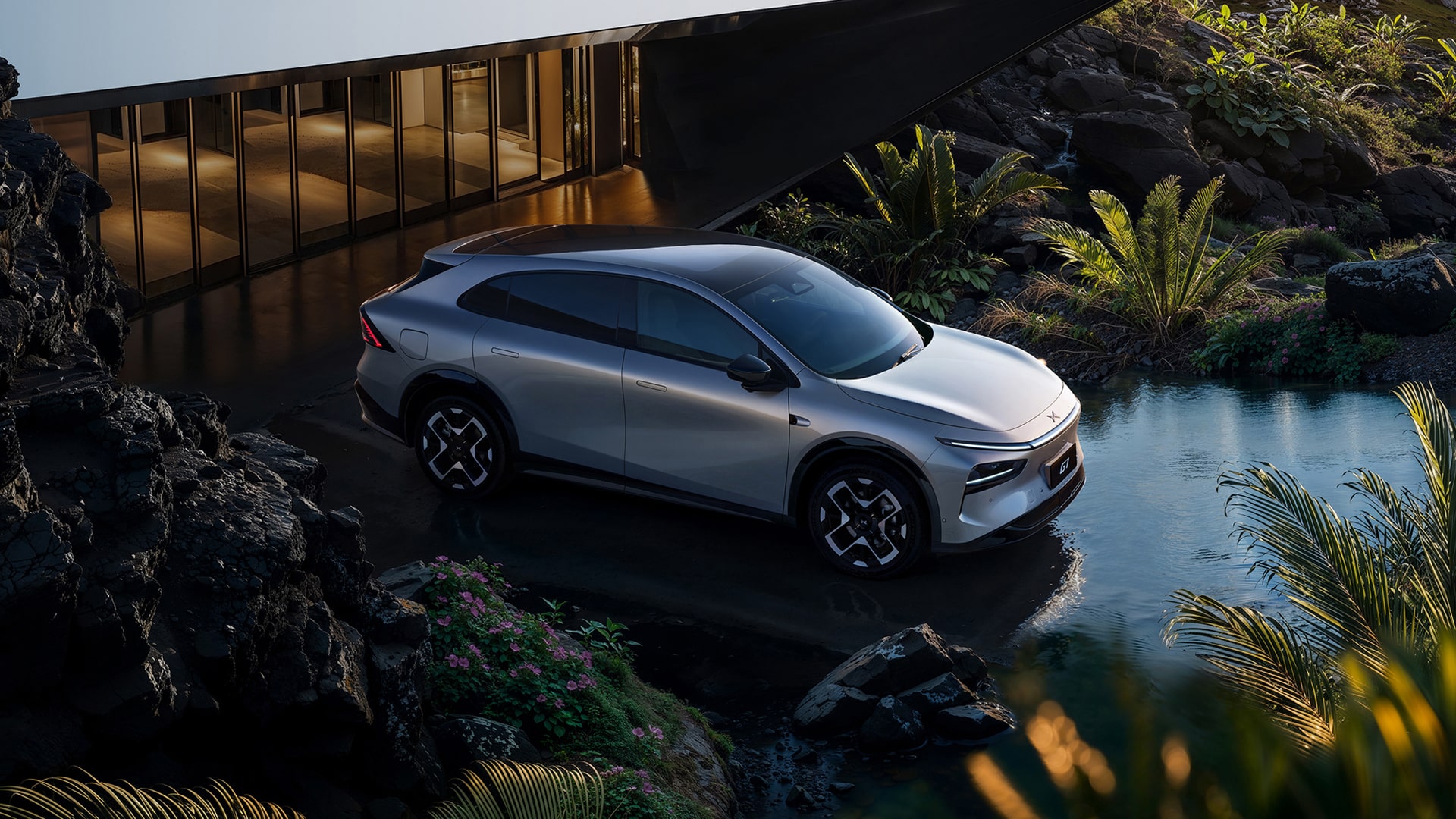
The year 2026 will mark a major product cycle for Xpeng as it rolls out a new generation of models that pair electric drivetrains with onboard fuel-powered generators. The setup allows vehicles to operate like pure electric vehicles in daily use while extending total range when needed. He Xiaopeng, the company’s chairman and CEO, has said Xpeng plans to launch seven models in 2026 equipped with this configuration. That lineup will include three updated versions of existing vehicles and four entirely new models built around the same system. To date, Xpeng has already introduced extended-range variants of several products, including the X9, P7+, and G7.
36Kr has learned from supply chain sources that the four all-new models will be the G01, G02, and two Mona-branded SUVs, codenamed D02 and D03. All four will be SUVs.
The G01 will be a high-end six-seat SUV measuring about 5.1 meters in length with a three-meter wheelbase. The G02 is positioned as a full-size flagship SUV, targeting competitors such as the Li L9 and the Aito M9. Among the two Mona models, the D02 will be a midsize SUV, while the D03 will sit in the compact segment.
Beyond expanding its range-extended lineup, Xpeng is also intensifying its focus on driver assistance technology. The company plans to deploy a unified vision-language-action system across both its Ultra-branded consumer vehicles and future robotaxi models.
At its first product launch event of the year, Xpeng unveiled four 2026 model-year vehicles, all of which emphasized upgrades to chips and artificial intelligence software. In post-event discussions, He repeatedly argued that the long-term value of AI would far exceed that of traditional performance improvements. That position is increasingly shaping the company’s product strategy, with AI emerging as the central upgrade focus for Xpeng’s 2026 lineup.
RELATED ARTICLE
Three levers Xpeng is pulling to build volume
A growing number of automakers have demonstrated that relatively affordable hybrid vehicles, designed to operate much like pure EVs, have become one of the most effective formulas in China’s automotive market. Xpeng’s sales growth in 2025 was driven in large part by the low-priced, fully electric Mona M03, which alone accounted for nearly a quarter of the company’s total deliveries.
In lower-priced segments, Xpeng plans to further expand its offerings with the launch of the two Mona SUVs, the D02 and D03.
Beyond the Mona brand, Xpeng will also introduce generator-equipped versions of existing models. This creates an opportunity to reset pricing. Vehicles using this configuration can be priced lower because the generator reduces the need for large battery packs, which remain one of the most expensive components in EVs. For example, the X9 variant equipped with a 63.3 kilowatt-hour battery and a generator starts at RMB 309,800 (USD 43,372), about RMB 50,000 (USD 7,000) less than the fully electric X9 with a 94.8 kWh battery.
Xpeng has already seen early traction from this approach. He has disclosed that orders for the generator-equipped X9 broke the model’s single-day order record within one hour of launch. According to 36Kr, the vehicle received roughly 8,000 orders within five days, exceeding the total sales of the fully electric X9 in the first five months of 2025. Data from Autohome shows that the pure EV version of the X9 sold 6,991 units from January through May 2025.
That momentum, however, comes as growth in the extended-range segment has slowed. Most mainstream brands have already introduced similar products, crowding the market and reducing the incremental gains available from this strategy alone.
He remains confident that over the next decade or two, drivers of traditional gasoline vehicles will continue to shift toward models that combine electric driving with fuel-based range extension. He has said Xpeng has taken the approach further than many competitors by pairing longer electric-only range with features typically associated with mid- and high-end EVs, including 5C fast charging and an 800-volt electrical architecture.
The result, in his view, is a more complete solution. These vehicles offer charging convenience closer to that of pure EVs while delivering longer overall range than most competing powertrain options.
Xpeng’s push into this configuration is not only about stabilizing sales in China. It also reflects the company’s overseas ambitions. Xpeng is accelerating its global expansion, with the P7+ and the Mona SUV among its key export models this year. According to 36Kr, overseas markets accounted for about 10% of Xpeng’s sales in 2025, and the company plans to double that share in 2026.
Driving assistance represents Xpeng’s second major growth lever. The company is accelerating deployment of its self-developed Turing chip alongside a second-generation vision-language-action system. Together, these technologies reinforce Xpeng’s technology-driven brand positioning and support clearer differentiation at the higher end of its lineup.
36Kr understands that Xpeng has already secured production capacity for more than one million of its self-developed chips.
The company is gradually migrating existing models to the Turing chip. In the newly released 2026 model-year vehicles, the Max trim replaces a dual Orin chip configuration delivering 508 TOPS of computing power with a single Turing chip offering 720 TOPS. A newly introduced Ultra SE version uses two Turing chips for assisted driving, while the top-tier Ultra variant deploys three. Two are dedicated to driver assistance, with a third assigned to the cockpit to support localized AI applications.
Other automakers, including Li Auto and Nio, are also accelerating the mass production of self-developed chips and large-scale models. Nio’s Shenji chip is already deployed on vehicles built on its NT3.0 platform, while Li Auto plans to introduce its M100 chip in 2026. Closed-loop integration of software and hardware is increasingly viewed as the next battleground for differentiation in smart driving.
Barriers Xpeng must overcome in its push for scale
“The competition in the automotive market in 2026 will be even more brutal,” He said recently during an exchange with industry peers. He noted that every automaker is operating under intense pressure and that, just as few predicted the rapid shifts seen in China’s car market a year ago, uncertainty over the next year remains high.
Leapmotor has publicly stated a goal of selling one million vehicles in 2026, including 900,000 units domestically and 100,000 overseas. Combined with Xpeng’s target of up to 600,000 vehicles, the two companies are seeking to capture a substantial share of the market next year. That growth, however, would need to come largely through displacement rather than overall market expansion.
China’s automotive market has entered a phase of stock competition. For Xpeng and Leapmotor to sell a combined 1.6 million vehicles in 2026, other manufacturers operating at similar price points would inevitably lose share. Under the current market structure, that pressure is most likely to fall on BYD and Geely.
Both BYD and Geely are expected to place greater emphasis on overseas markets in 2026 while defending their positions at home. According to 36Kr, BYD is targeting overseas sales of 1.6 million vehicles next year, with international markets expected to generate the bulk of its profits. Domestically, BYD is likely to maintain a low-margin strategy to sustain competitive pressure. Geely, meanwhile, is expected to concentrate resources on its rivalry with BYD.
For Xpeng and Leapmotor, success will depend on maintaining strong value-for-money while outperforming rivals on selected metrics. Leapmotor is focused on the RMB 100,000–200,000 (USD 14,000–28,000) segment, emphasizing affordability. Xpeng is targeting the RMB 150,000–250,000 (USD 21,000–35,000) range by pushing advanced driver assistance features into lower price brackets. As a result, driving assistance capability and value are converging in the RMB 100,000–250,000 market.
Xpeng is moving quickly into the hybrid space, while Leapmotor is rolling out four major product lines spanning RMB 100,000–300,000 (USD 14,000–42,000). In 2026, Leapmotor plans to launch four to five all-new models, including two D-series vehicles and two A-series models, alongside multiple updates to its B- and C-series lineup.
All of this expansion depends on sustained high growth. Rapid growth, in turn, requires organizational structures, supply chains, and operating systems to scale in parallel.
For newer automakers, annual sales of 500,000 vehicles are widely seen as a systems threshold. Beyond that level, product variations multiply, supply chains grow more complex, and coordination costs rise sharply, increasing the risk of execution errors.
Li Auto was the first among the newer generation of carmakers to approach this milestone. Its subsequent experience has shown how management challenges can be amplified after crossing it. Whether Xpeng and Leapmotor can clear the same hurdle smoothly will be closely watched.
KrASIA Connection features translated and adapted content that was originally published by 36Kr. This article was written by Xiao Man for 36Kr.